


With the goal of becoming Program Management Professional (PgMP) certified, I was now 28.5 hours into the process with an approved application in hand and next steps identified. I was finally (FINALLY!) at the point where I had to learn something new. Specifically, the Project Management Institute’s (PMI’s) core doctrine on program management: The Standard for Program Management (SPM) (1).
But the SPM’s no page-turner, and the exam’s very difficult (see “Part 6: What Does It Take to Pass the PgMP Exam?”). Reading the SPM straight through wasn’t going to cut it. To internalize the information, I needed to build myself a lesson plan. One that included all the steps you find in a classroom: a teacher to explain the complexity away and homework to force deeper thinking.
Taking a true do-it-yourself (DIY) approach, here’s how I learned the SPM.
And how long it took…and how much it cost.

- Image created in Gemini on 8/26/2026
About the “Project PgMP Certification” Series
In this series, I share my journey toward PgMP certification, including my experiences with the application, educational materials, and exam. If you are considering the PgMP certification or curious about a mid-career educational adventure, this series is for you. In Part 7, I describe my experience learning the SPM and hope it helps you develop your own best approach to studying for this exam.
While I strive to include accurate details about the PgMP certification process, the PMI is the final authority on all requirements and processes. Make sure to check out PMI’s PgMP website and the PgMP Handbook (2) for updates.
What is “The Standard for Program Management?”
In its purpose statement, the PMI states “The Standard for Program Management provides guidance on principles, practices, roles, and activities of program management that are generally recognized to support good program management practices and are applicable to most programs, most of the time” (1, p. 3).
My shorter version: the SPM describes the discipline of program management.
The textbook itself – see a picture below – is not a behemoth akin to that of the chemistry textbook you lugged around in high school, but it’s no lightweight either. Coming in at 247-pages and 5/8ths of an inch thick, it’s a tome of dense technical text with a smattering of graphs and tables.
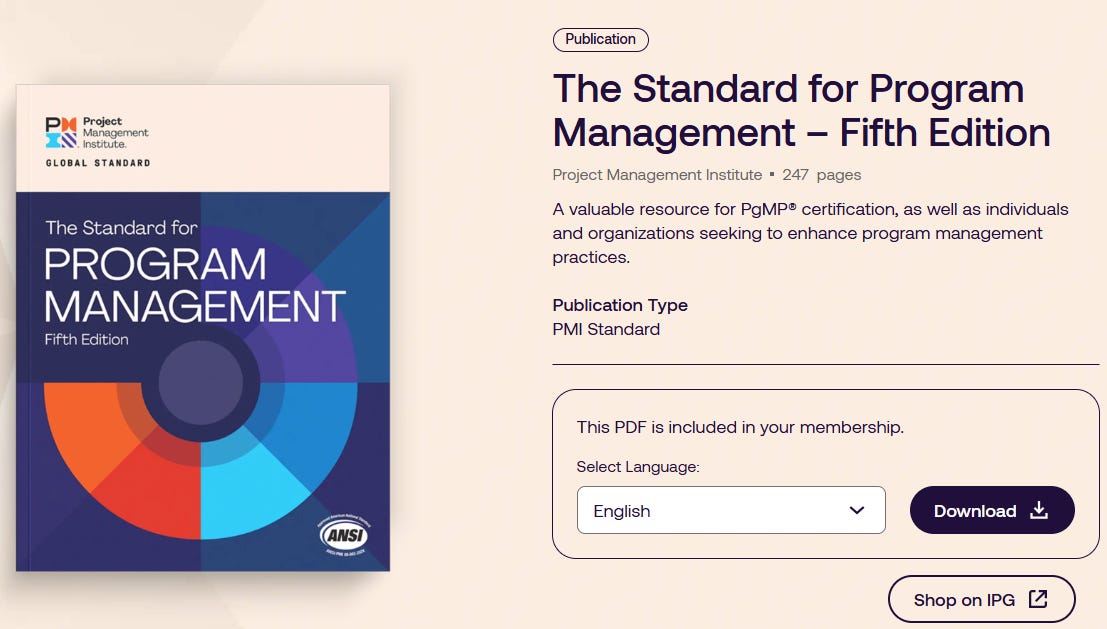
- Figure 1. The Standard for Program Management. Source: PMI website (accessed 8/27/2026) (3).
The book's content is best divided into four main sections plus supporting materials.
Section 1 – Introduction (p.1 - 36, 14%)
Section 2 – Program Management Principles (p.37 - 62, 10%)
Section 3 – Program Management Performance Domains (p.63 - 150, 36%)
Strategic Alignment
Benefits Management
Stakeholder Engagement
Governance Framework
Collaboration
Life Cycle Management
Section 4 – Program Activities (p.151 - 176, 11%)
Appendices, References, Glossary, Index (p.177 - 247, 29%)
To summarize, Section 1 tells you what programs are and how they differ from projects and portfolios. Sections 2 through 4 break down the profession into different frameworks (principles, performance domains, and activities). Then there’s a bulky set of additional info in the appendices, references, glossary, and index.
Among them, “Section 3 - Program Management Performance Domains” stands out as the largest and most important, most closely aligning with the PgMP “Exam Content Outline” (4).
Can you just study the SPM?
Yes, but really no.
In content, the SPM fully meets its intended purpose: to define the profession. It focuses on structure and definition, but not on conceptual examples or detailed descriptions of how the activities are performed.
Put another way, if the SPM were a cookbook, it would tell you what cooking is and break the entire world of cooking down into regions, styles, techniques, and ingredients. But only in the briefest of descriptions. There are no recipes, no attractive pictures of appetizing meals, and certainly no entertaining teacher guiding you along the cooking journey. You’re on your own with this book, and until you crack a lot of eggs, your pasta carbonara is going to turn out mushy… or burnt…or both.
And that’s not a dig at PMI. This minimalist approach is wise. It kept the book - which covers a huge range of material - to a manageable length. Further, as this “Global Standard” is meant to apply to all programs, across all industries, across the world, the generalist approach ensures the PMI doesn’t accidentally exclude any sector from under its stated umbrella. All told, the SPM is a high-quality and impressive text; it just isn’t designed to teach you program management.
And for this self-studier who only learned program management through work experience, that presented a problem. Thus brought in the need for a lesson plan.
The core tenets of my three-step lesson plan
Having committed to the self-study approach (see all my reasons why in “Part 3: Tackling the PgMP without a Boot Camp—”Wicked Smaht” or Dumb?”), I knew I’d have to break the material apart into focused chunks of learning, each needing:
A teacher – someone or something to explain the material in an accessible way
The SPM – the definitive, jargon-heavy textbook
Homework – activities to force me into deeper learning about the content.
While Step 2 was obvious, how to approach steps 1 and 3 was anyone’s guess.
Step 1: Finding my PgMP “Teacher”
Recognizing that I needed a primer before hitting the SPM version, I reviewed PgMP teaching options online (sans bootcamps). These largely came in three categories:
On-demand courses from the big project management training companies such as PMTraining ($598) or PM Training School ($399)
Pre-recorded online courses from Coursera or Udemy (~$10 - $100).
Study Guides (i.e., the old-fashioned book) (~$30 - $50)
Because I wanted to keep costs low, I was torn between categories 2 and 3, each with a sizable number of options, but little by way of quality verification. Since my peak standardized testing era as a high school and college student was during the 2000s - when hard-copy study guides reigned supreme - my instincts leaned into that nostalgia and led me to category 3: another textbook.
I ended up purchasing the Program Management Professional Handbook (5) by Anand Vijayakumar (2nd Edition) for $48.86. Writing this more than a year later, I admittedly can’t recall exactly why I chose this book over the other study guides presented on Amazon (sorry), but that’s the one I got.
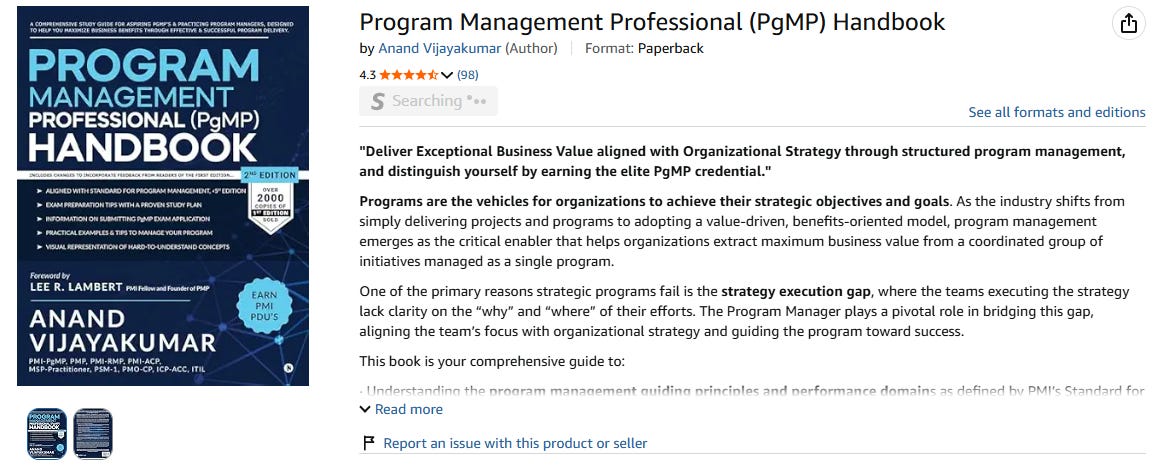
- Figure 2. PgMP Handbook. Source: Amazon website (accessed 8/27/2026) (6).
Sidestep: Creating my study schedule
I then spent the summer casually flipping through the PgMP Handbook and SPM whenever I could. Initially, I gravitated toward the sections where Mr. Vijayakumar helpfully described his own experiences preparing for the PgMP exam. In particular, I gobbled up his sample study schedule (5, p. 206), which broke key topics down week by week.
Using Mr. Vijayakumar’s version as a template, here’s my original study schedule. Looking at it now, I must have already covered the material in SPM’s Sections 1 and 2, as it starts right in on a performance domain.
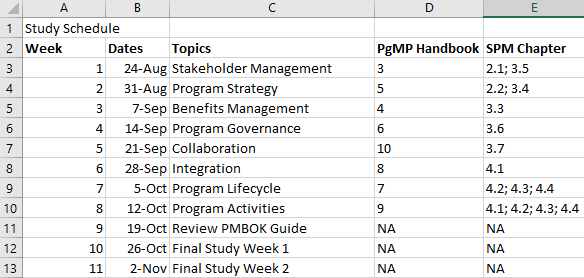
- Figure 3: Internal files of CHF Program Consulting, LLC; 2026 Aug 27. (7)
This schedule was tremendously helpful as it gave me the confidence to schedule my exam for ~2.5 months away. My ambition was to wrap this whole certification up in a tidy bow before Thanksgiving. But – spoiler alert – I did end up pushing the exam out another month. More details to come in the next article about practicing for the test.
Step 2: Tackling the SPM
Fortunately, I chose pretty well with the PgMP Handbook. Mr. Vijayakumar writes clearly and with a solid teaching “voice,” breaking down difficult concepts logically. His book was the classroom lecture before you hit the textbook.
Once I finished a section in the Handbook, I then flipped over to the SPM. Essentially, I was moving from medium to hard mode on the material, hitting the highly technical, dense language on each subject with SPM. This largely worked, and I found I could digest the information and wasn't often confused by its complexities.
Then after each section, I put myself to work “thinking” about the content through homework.
Step 3: Divining my best homework assignments
When it came time to assign myself “homework” to apply the concepts, the activities came together organically. Through some trial and error (I wrote flashcards, but never really returned to study them), I found two productive activities that pushed me and cemented the lessons.
Homework #1: Flow charts
In reading about the performance domains, I noticed each domain had its theoretical underpinnings, followed by a steady list of highly tactical steps. It sparked the idea that I could visualize the information, so I started mocking up “flow charts” in Google Draw. Here’s one I drew about engaging stakeholders.
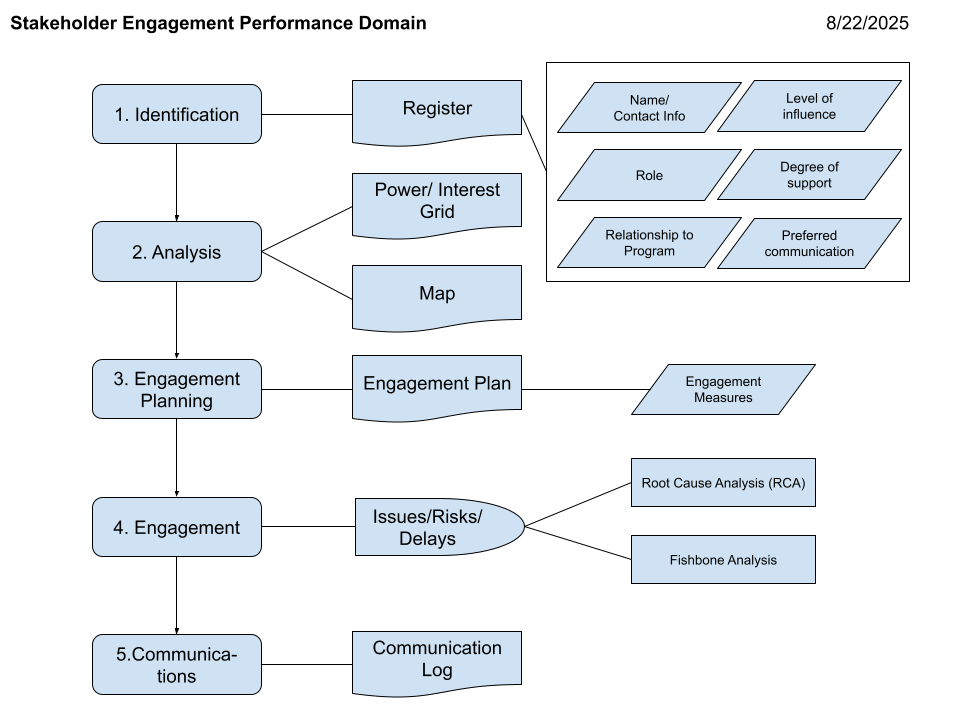
- Figure 4: Stakeholder Engagement Flow Chart, Internal files of CHF Program Consulting, LLC; 2026 Aug 27. (8)
This flow chart came together fairly logically and looks pretty orderly. Some of the others were not so tidy. For instance, the “Governance” flow chart is a spider’s web of arrows, and the Strategic Alignment has nearly 40 boxes of activities and measures. But regardless of how pretty or ugly they turned out, I gained the value of repetition as I did another close read of the related SPM material, identifying and typing out all the major keywords. Further, visualizing the domains let me see each domain’s level of complexity, something hard to pick up from reading alone.
Homework #2: Essays
And then I started to grapple with the information presented. What made sense to me? What didn’t? How useful was it in the real world, and how much did it reflect my lived experience? Conveniently, I already had a forum to put my thoughts (i.e., this Substack!), and I started writing up essays for “The Non-Profit Program.”
It all started with the “Streamline your Stakeholder Engagement” plan, my attempt to balance the helpful steps outlined in the SPM with the reality of a program manager's bandwidth. From there, I kept writing and ended up creating 10 articles.
Strategic Alignment: Closing a Strategy Gap
Benefits Management: Programs: It’s All About the Benefits
Stakeholder Engagement: Streamline Your Stakeholder Engagement Plan
Governance Framework: Your New Best Friend - The Program Management Office (PgMO)
Collaboration: Creating Ripples with Collaboration
Life Cycle Management: “Finding Your Finish Line” Series (Parts 1, 2, 3, 4, 5)
As you can see, “life cycle management” sent my head spinning into a 5-part series because I couldn’t resolve every program needing a close. I would keep writing about that topic even several months after I sat for the PgMP exam.
Under the premise that you don’t really know what you think until you write it down (a paraphrase of Joan Didion’s New York Times essay “Why I Write?" (9)), constructing these essays pushed me to discover what I actually thought about PMI’s approach to program management. In doing so, I connected with the material in a way that truly cemented the concepts in my brain. Something one absolutely needs to do before attempting the exam.
Wrap up: Lesson plan, time, and cost
I succeeded at learning “The Standard for Program Management” through self-study!
It took me an estimated 87 hours over four months and cost $174.51. Certainly cheaper than a four-figure bootcamp and a fulfilling self-journey. On the other hand, it took a lot of time and gritty determination, and going it alone is also lonely.
But to summarize my approach for those looking to develop their own lesson plans:
Casey’s PgMP Lesson Plan
Intro Lesson: Read the concept in the PgMP Handbook (~30 – 45 minutes per topic)
Technical Lesson: Read the same topic in the SPM (~30 – 60 minutes per topic)
Homework #1: Create a flow chart of the tactical activities around the topic (1-2 hours per chart, Performance Domains only)
Homework #2: Write an essay analyzing your thoughts on the topic (8 – 10 hours per topic, Performance Domains only)
Time
Unfortunately, I wasn’t diligent about tracking the hours I spent studying the SPM material, but here’s my estimated time breakdown.
1) Reading the PgMP Handbook – 223 pages, 6 hours total
2) Reading the SPM – 196 content pages, 8 hours total
3) Flow Charts – 10 hours total
4) Essays – 63 hours total
Clearly, the essays took up the bulk of my time. As I wrote them for publication, I worked far past the point of productive learning. You could likely halve that time to 4 hours per essay, bringing the essay total to 24 hours. Using this approach, I predict that you could solidly learn the SPM in under 50 hours.
Cost
For costs, I bought two books.
The Standard for Program Management: $125.65 (2 copies)
Program Management Professional Handbook: $48.86
My total was $174.51, but it should have been $108.63! Unfortunately, I bought the SPM twice ($59.77, $65.88) when my first copy mysteriously disappeared. After hours of searching, I bought a new one, only to find the original stuck behind a bookshelf about a month later. 🙁 Mystery solved, but it still vexes me a little.
“Icarus”
How do you learn the Standard for Program Management? The simple answer is by reading the SPM. The long, or 87-hour, answer is by surrounding the SPM with supporting material and activities.
And now that I had the SPM under my belt, could I jump right into the exam and pass? Well, no...
The next steps awaited me: practicing the exam until I excel at the format, and building the mental stamina and speed to get through the four-hour, 170-question test. How I practiced for the exam is the next topic in Part 8 of the “Project PgMP Certification” series.
And I won’t leave you without an article song pairing. For those long hours of studying, here is a lead song in Spotify’s Gentle Classical Sleepy Mix, “Icarus” by Tony Ann. This station is great background music that strikes the right balance between stimulating and soft.
References
Project Management Institute PMI. The Standard for Program Management - Fifth Edition. Project Management Institute; 2024.
PgMP ® Program Management Professional (PgMP) ® Handbook Contents [Internet]. [cited 2026 Jun 11]. Available from: https://www.pmi.org/-/media/pmi/documents/public/pdf/certifications/program-management-professional-handbook.pdf?rev=d0f4f6474e9d4c07b8b9bb8786303973
The Standard for Program Management – Fifth Edition [Internet]. Pmi.org. 2024 [cited 2026 Aug 27]. Available from: https://www.pmi.org/standards/program-management-fifth-edition
Program Management Professional (PgMP) ® Examination Content Outline (ECO) [Internet]. 2024 [cited 2026 July 21]. Available from: https://www.pmi.org/-/media/pmi/documents/public/pdf/certifications/pgmp-exam-content-outline-english.pdf?rev=74f6af64c47f40e183f13743603851d5
Vijayakumar A. Program Management Professional (PgMP) Handbook. 2nd Edition. Notion Press; 2025.
Program Management Professional (PgMP) Handbook [Internet]. Amazon. [cited 2026 Aug 27]. Available from: https://www.amazon.com/dp/1649195788?ref_=ppx_hzod_title_dt_b_fed_asin_title_0_0
CHF Program Consulting, LLC. Internal file archive: Original Study Schedule [photograph]. 2026 Aug 27. Unpublished.
CHF Program Consulting, LLC. Internal file archive: Stakeholder Engagement Flow Chart [photograph]. 2026 Aug 27. Unpublished.
Didion J. Why I Write. The New York Times [Internet]. 1976 Dec 5 [cited 2026 Aug 27];. Available from: https://www.nytimes.com/1976/12/05/archives/why-i-write-why-i-write.html
Disclosure: In writing this series, I am not employed or compensated by PMI in any way. My affiliation with PMI is solely as a member and PgMP certificate holder. The experiences and opinions included here are my own.