


This past month, Harvard Business Review (HBR) gave project management its big spotlight: publishing the article “The Project-Driven Organization” by Antonio Nieto-Rodriguez. Listening to his interview on HBR’s Ideacast, this part of the conversation stood out (1):
Antonio Nieto-Rodriguez: “I asked two questions to a board of directors or executives, “How often do you launch new initiatives, new projects in your organization?” They say, “Maybe we launch twice per month.”
And they’re very proud because launching projects means that you’re taking risks, you’re innovative. But then I ask, “How often do you finish them or you close them?” And they look to each other, say, “Maybe I think the last time we finished a project was six months ago.”
Mr. Nieto-Rodriguez goes on to explain how this lopsided open-to-close rate quickly becomes a problem and recommends keeping projects short (< 6 months). In that discussion, though, I also heard compelling evidence related to program closure: humans are really bad at ending work.
If businesses struggle to close projects as Mr. Nieto-Rodriguez suggests, how do we ever get the courage to close entire programs, a transformation vehicle that arguably has a much higher bar for achievement (benefits for programs vs. structured deliverables for projects)?
Businesses need underlying systems that encourage program management professionals (PgMPs*) to work towards program closure. For senior leadership, the low-hanging fruit is to train your workforce on program lifecycles and the closure phase, as well as to ensure closure criteria are included in all program charters, plans, schedules, etc.
While all of this is needed, it is insufficient to effectively drive PgMPs to actively pursue closure. As leaders, your top priority for facilitating program closure is to provide PgMPs with the psychological safety to actually aim for it. To do this, you will need to answer these three tough questions.
What’s my next job?
What happens to all my hard work?
Will you judge my work fairly, particularly if the program’s results are bad?
If you back these questions with solid answers, your PgMPs will work hard and raise their hands to openly propose a program’s transition to operations or even cancellation, if warranted. But if you leave these questions open-ended, then PgMPs will only be human. They’ll work within the system they’re given, where keeping their program going is the best way to protect their livelihood, work product/expertise, and career trajectory. I know this because it’s how I was trained as a PgMP in the non-profit workforce.
So how do you build systems that answer those questions for your PgMPs?

About the “Finding Your Finish Line” series
This past summer, I wrote the “The Great Uncertainty” series, five articles focused on navigating the prospect of program cancellation for PgMPs affected by the federal funding cuts.
This series is meant to explore the other half of that closure coin— why and how do we intentionally manage our programs toward a favorable ending? In studying “The Standard for Program Management” (2) by The Project Management Institute (PMI), I found a significant difference between their guidance on program closure and my field experience, suggesting that “positive program closure” remains somewhat of a mystery for non-profits. This final article, Part 5, is written for executive leaders and portfolio managers to outline the infrastructure needed to support PgMPs in successfully closing programs.
1) What’s my next job?
When you join a consulting company or Project Management Organization (PMO), there’s an inherent expectation that leadership will assign you to new work. Fluidity is built into the model, and the systems are set up to move you between assignments. “What’s my next job?” isn’t too intimidating a question in these environments. But that’s not true everywhere, particularly at large, highly siloed non-profit institutions such as academic medical centers and colleges.
These organizations often follow a traditional model in which a PgMP is hired to manage a specific program within a department dedicated to a specific subject area (i.e., the opposite of a generalized department of project and program managers). For example, I was hired at Boston Children’s Hospital (BCH) in 2014 to manage the Integrated Care Program, which lived within a larger unit called Network Development and Strategic Partnerships. This model remains common across the non-profit industry. Here are two job descriptions I pulled from LinkedIn yesterday that show a similar setup.
Senior Program Manager, MassHealth Health Equity Program
Program Manager of Workforce Training & Continuing Education Apprenticeships
This traditional hiring model does not naturally encourage job mobility; therefore, the default answer for a PgMP looking to close their program is: “You’re out of a job.” Leadership and human resources are not set up to easily move strong performers between initiatives (particularly if it means transferring departments). For example, at BCH, a change in job required a PgMP to identify, apply for, and be selected for a new position, similar to an external candidate. An onerous, time-intensive process where the responsibility sat almost exclusively with the employee. Further, all that work and interviewing had to be conducted covertly as job seeking - even internally – could equate to dangerous perceptions of disloyalty with your current management. That culture was beginning to change when I left in 2022, but it was nonetheless challenging to seek new opportunities outside one’s station.
To encourage PgMPs to work toward program closure, I’m not recommending that non-profit organizations overhaul their organizational structure or hiring practices. Program-specific hiring offers many benefits: it’s plainly a great way to attract new employees. Rather, an organization needs a strong internal job-transition system in place, where knowledge and accountability are owned not solely by Human Resources (HR), but by the leaders who set the organization-wide strategy.
A stronger system starts with strategic leaders who view the organization’s entire project and program management workforce as a cohesive unit, regardless of departmental boundaries. If you are one of those leaders, have you ever counted all the project and program staff across your organization? Looked at how they progressed up the career ladder? Assessed if they have a common foundation of skill sets? Seen if they are moving between initiatives or staying put?
Leadership also needs to be keenly aware of which initiatives are opening and closing, identifying strong performers, and determining the best staffing for programs and projects as strategic priorities change. The structural setup could take many forms, such as a dedicated PMO/PgMO or leadership tasked with overseeing project and program management staff development. Regardless of how the structure metastasizes, the end goal should be that, if a PgMP shows up at your door and asks, “What’s next?”, you have an answer.
2) What happens to all my hard work?
No one wants to work on an initiative only to see their efforts die on the vine. A PgMP who cares about their work will protect it. If there’s little expectation that anyone else will be responsible for the work, the program will never close.
Based on “The Standard for Program Management” (1), the ideal model is for programs to develop improvements and then handoff those activities to an operational counterpart for ongoing sustainment of the intended benefits. While that’s the ideal, I’m highly suspicious that these transitions happen all that smoothly in any industry. For instance, while studying for the PgMP certification exam, I encountered many practice questions that asked what I would do if my operational counterpart resisted the handoff. My guess is that there’s a practical reason why PMI wants you to be prepared for such challenges.
Based on my experience at non-profits, where the distinction between transformation and operations is often ambiguous, a handoff to operations can be highly fraught. That’s where you come in as a leader. To support program closure, you need to build bridges between your transformational initiatives and operations.
That all starts with developing the organization’s understanding of which work units are transformational vs. operational, and with an expectation that one hands off to the other. I was always thrilled to present to the chief medical officers or administrative directors at BCH on new functionalities that supported care integration. But I knew my words were merely suggestions, not a transfer of responsibility. Furthermore, given an academic medical center’s siloed, broad structure, no single unit ever existed to handoff oversight of these care-delivery improvements. Thus, “The Integrated Care Program” wasn’t going anywhere if we wanted our work to be used.
At your organization, what’s the relationship between transformational initiatives and operational units at your organization? Are there processes and forums in place for clear handoffs between the two? Are your transformation teams empowered to truly give ongoing responsibilities to operations? Most importantly, how are you using your power and influence to foster connections and champion these handoffs?
These cross-organizational relationships are the places where strategic leadership is needed to broker the exchange of responsibilities. If you can build strong bridges for that transfer, your PgMPs can succeed in their program closure process and set themselves up to move on to new, higher-priority initiatives with a clear sense that their past work will be sustained.
3) Will you judge my work fairly, particularly if the program’s results are bad?
Another barrier to program closure is when there’s a gap between leadership expectations and the PgMP’s work product. Two primary ways this crevasse manifests are when leadership evaluates PgMP job performance against the wrong success criteria and when PgMPs fear delivering bad project outcomes, believing they will be conflated with poor performance on their part.
As a leader, you need:
To judge programs and PgMPs’ job performance based on criteria that are correctly aligned with the stage in the program’s development, and that’s often not “did you successfully implement and generate benefits.”
To support a culture of openness to receiving bad results, enabling PgMPs to make honest recommendations on whether a program should continue or not.
It’s unclear whether this is common knowledge, but programs are highly risky endeavors – far more than projects that have the advantage of highly specified deliverables (3, p. 41). A program is designed to deliver benefits, and for a novel program, its path to that goal is largely uncharted. For a large part of a program’s lifecycle - particularly one built to actualize a new idea - the PgMP’s role is to learn, analyze, and recommend next actions. With each discovery, they hopefully move closer to identifying the optimal operational model to deliver the desired benefits, but there are no guarantees.
I break this journey down into three distinct phases.
Research: The evaluation of whether the core idea can deliver the desired benefits.
Development: The creation and testing of a prototype model to deliver the desired change.
Implementation: The application of the final, scalable model across the organization and subsequent measurement of benefit delivery.
For the first two phases of a program’s lifespan, success for a program manager is “Did you learn something?” That something could be “It worked!” or “Hard no!”, and both outcomes are technically a success. The business value generated is the knowledge. But there is also tension for leaders when their idea fails to deliver the desired results. The ability to mentally pair that bad news as organizational value and view the PgMP as a strong performer requires a mental deadlift on your part.
Only in the third, implementation phase is a program focused on creating large-scale change across the organization and generating significant benefits (e.g., profits, improved social/health/educational outcomes, etc.). At that point, you can absolutely judge a PgMP's performance by their ability to deliver on the implementation and the value it provides to the organization.
To support a program through these phases to its eventual closure, leadership needs to establish a system for fair performance evaluation. In considering your evaluation methodology, be particularly aware of these two major pitfalls that can cause program derailment:
Leadership expectations become misaligned with the program phase. Most commonly, leadership expectations jump to implementation and benefit generation before the research and/or development phases are complete.
The organizational culture only communicates successes. If leadership is not open to hearing that the idea they sponsored is failing or doing so is uncommon, a PgMP will not communicate openly, particularly not about closure.
Both scenarios can cause program management staff to withdraw and become defensive. The program is then vulnerable to spiraling off course, jumping from project to project to chase down the wrong outcomes, and never creating an optimal model for scalable implementation. It’s not solid professional behavior on the PgMPs' part, but if you're asking for something they aren’t capable of delivering yet, or there’s no way to fail without damaging one’s career, your incentiving a program in stasis.
As a leader, you need to signal that you understand programs are risky, that results in the initial phases will focus on knowledge, and that knowledge might contradict your original assumptions. If you build that foundation, PgMPs can be transparent and communicate openly, a necessity for healthy program-building that can progress to scalability, benefit generation, and closure.
Creating safe passage
Remember the last graduation you attended. The pomp and circumstance, nice speeches, that endless list of mostly strangers’ names read until you or the person you care about finally gets to walk across the stage. It may have been thrilling or completely boring, but it did provide value.
Specifically, graduations are a safe and encouraging way to bring a large group together to conclude their participation in one program and move on to the next.
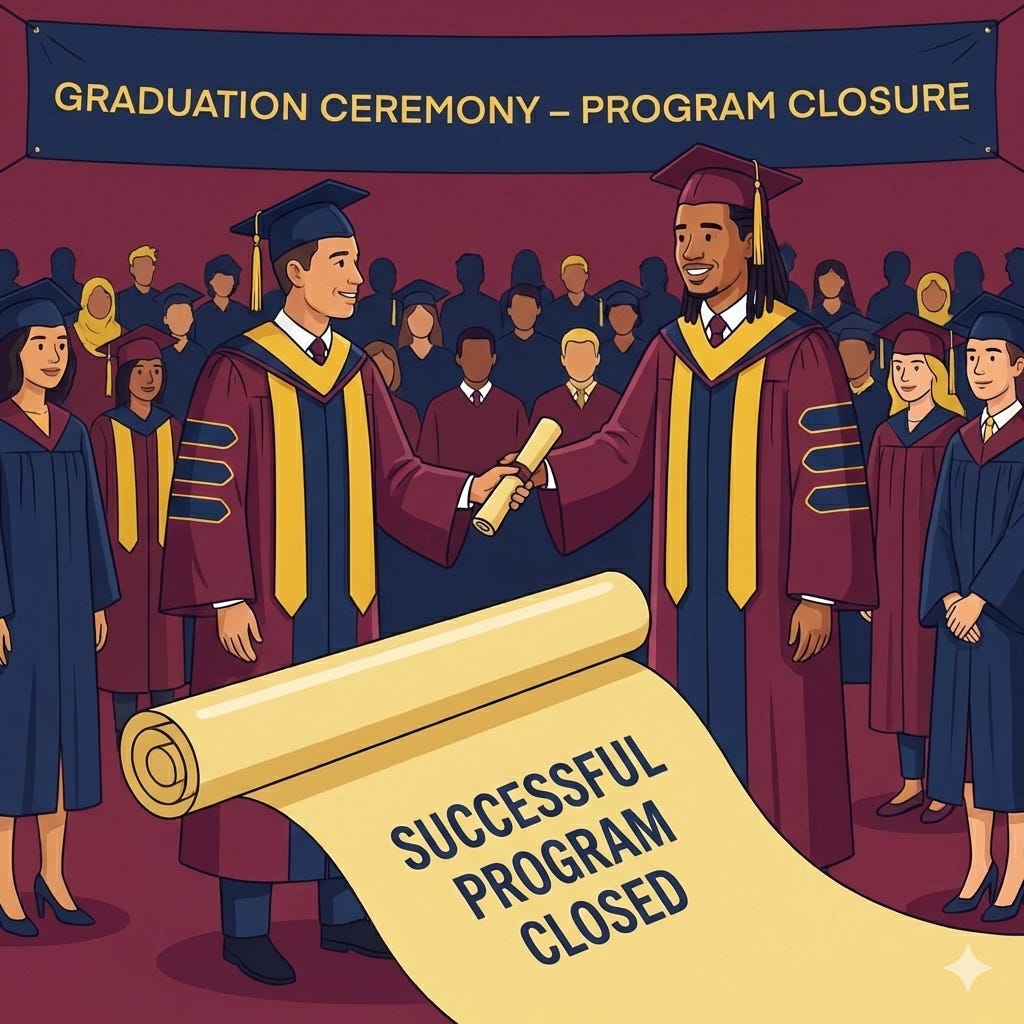
If you are a leader overseeing a portfolio of programs and projects, you are responsible for creating that safe passage for your staff. You don’t need a literal ceremony; instead, create systems that reassuringly provide your PgMPs with a) their next job, b) a place for the program’s work to continue, and c) a fair system for evaluating their program’s output. These are the foundations needed to encourage people to work at their best and towards positive program closure.
“Goodbye, Old Girl”
Thank you for sticking with me through this series on positive program closure. In writing so extensively about this one subject, I found many answers to my questions about this elusive part of the program’s lifecycle. Particularly about understanding that program closure is ideally about a transition, not an ending. Also, there are many significant benefits to developing programs that “keep the end in mind” (4, p. 23).
On that theme of closure and saying goodbye to this series that I’ve been writing since November, this article’s music pairing is the best goodbye song that I know. Another Broadway tune, “Goodbye Old Girl” from Damn Yankees.
It starts quietly enough, but ends with a climactic ballad as the senior Joe transforms into his younger self, closing off his current life for a second shot at becoming a professional baseball player. Here’s Jordan Donica singing that dramatic ending in a recent production at the Arena Stage (Washington, D.C.). Goodbye, old girl.
References
The Case For Becoming a Project-Based Org [Internet]. Harvard Business Review. 2026 [cited 2026 Feb 5]. Available from: https://hbr.org/podcast/2026/01/the-case-for-becoming-a-project-based-org
Project Management Institute PMI. The Standard for Program Management - Fifth Edition. Project Management Institute; 2024.
Vijayakumar A. Program Management Professional (PgMP) Handbook 2nd Edition. Notion Press; 2025.
Donovan J. Small Town Big Impact. 2023.
*In “The Non-Profit Program,” I refer to the term program management professional with the acronym PgMP to include anyone working or interested in program management, regardless of their official job title or credentials. This Substack is for everyone. This usage differs from the PgMP credential, where “PgMP” after a person’s name denotes successful completion of the Program Management Professional certification offered by the Project Management Institute (PMI).
Hi Casey, in my world, the operational staff, which is effected by the project (or program) participates in the project the whole time. I guess this is typical for environments, where the project is about a product, a service or an organisation to be set up or changed for future ongoing operation. In this instances you have dedicated project staff focussing to realize the project goals and part time operational staff designing their own future destiny. Sometime even dedicated staff members switch to operations at the end of the project. There are also projects, where the product gets sold to a customer at the end of the project and than everybody moves to the next project. But in the setting you describe I would recommend to make the operational staff a participant in the project from start to finish.