


I’m back from summer vacation. Thank you for waiting through that brief pause in the publishing schedule. We are now onto Part 6 of the “Project PgMP Certification” series, and there is still a lot of ground to cover. Let’s take a moment to recap.
Last time on “The Non-Profit Program”
One year ago, I found myself looking for a better way to manage programs. Having experienced a convoluted program failure and in the hot seat to manage a new one, I wanted to avoid repeating past mistakes (Part 1). I saw PMI-hosted offerings specific to the discipline of program management, distinct from project management. With a little more investigation, I decided to pursue a PgMP certification (Part 2).
With no one in my professional community holding a PgMP, I worked independently to figure out the process. This started with a decision to pursue the self-study route (Part 3). Following PMI’s “Path to a PgMP certification,” I confirmed that my work history met PMI’s eligibility criteria and started the application. A long 25.5 hours and an $800 exam fee later, the panel review was a success, and I had passed the application (Part 4 and Part 5). Yeah!
Now, in the words of my favorite fictional president, Jed Bartlet, “What’s next?”
PgMP exam time…or is it?
Going back to PMI’s instructional guide, the recommended next steps are “Step 3: Pay and schedule the exam,” followed by “Step 4: Study for the exam.”

- Image taken from PMI’s PgMP Certification webpage on 7/21/2026
With the payment submitted, the rest sounded straightforward: set a date and start studying. The only problem was that, with no insight into the material or the exam itself, I did not know how far out I should set the big day. A month? Half a year? More?
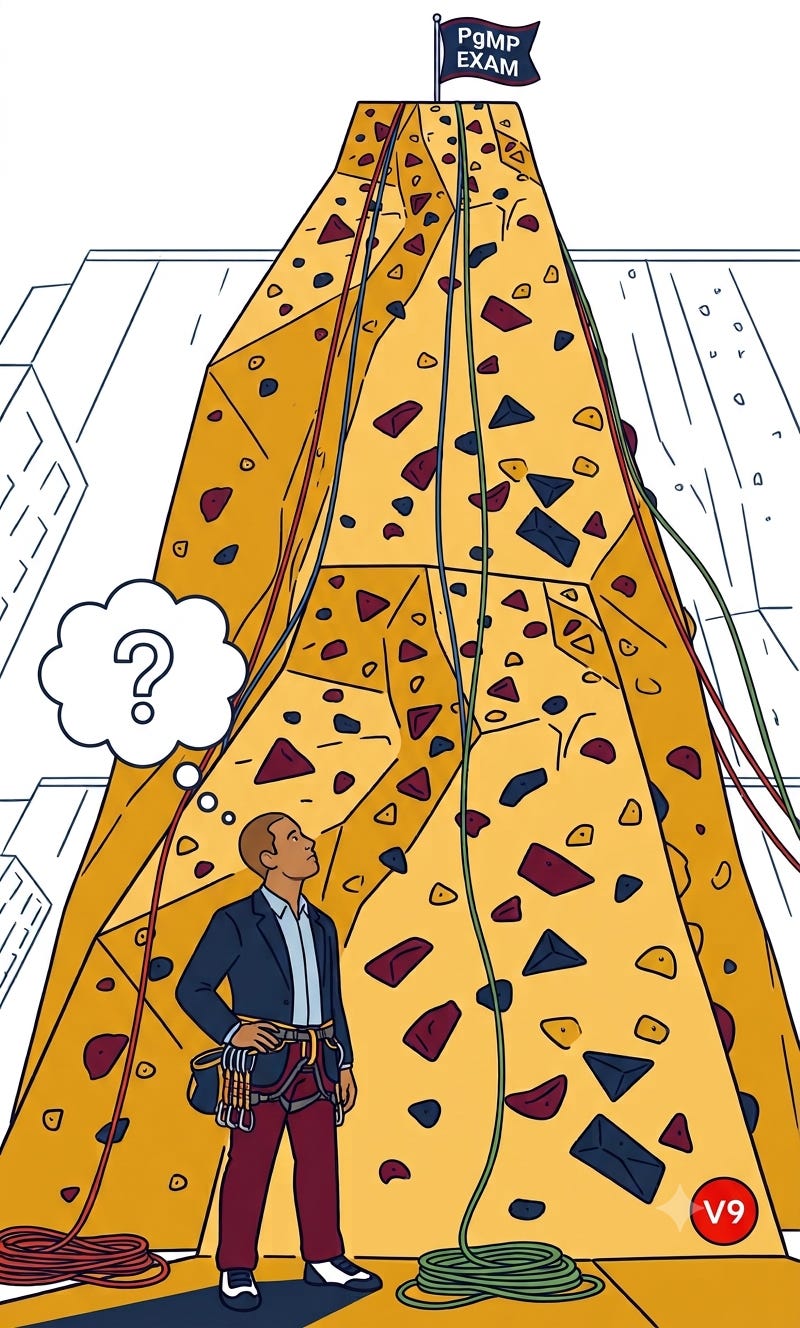
Thus launched a slew of questions not detailed in the “Path to a PgMP Certification.” Before I could set a date, I needed to figure out “What does it take to pass the PgMP exam?”
- Image created in Google Gemini on 7/23/2026
About the “Project PgMP Certification” Series
In this series, I share my journey toward PgMP certification, including my experiences with the application, educational materials, and exam. If you are considering the PgMP certification or curious about a mid-career educational adventure, this series is for you. This article, Part 6, describes the exam and key study material to help you develop a personalized approach to studying for the PgMP.
While I strive to include accurate details about the PgMP certification, the PMI is the final authority on all requirements and processes. To that end, if you are starting the PgMP process, make sure you read the “PgMP Handbook” (1).
Easy or Hard?
When I think about an exam on program management, I envision scenarios along a spectrum from easy to challenging.
Easiest Scenario: The content is elementary, and I can mostly intuit the answers based on deductive reasoning and life experience. Little study is required, and I can probably take the exam within the month.
Hardest Scenario: The content is advanced and largely new information. The exam is extremely difficult, and I have a significant amount of learning ahead of me. Timeline for taking the exam is six months or more.
To identify whether I was nearer the easier or harder end of this range, my main hint was hearing from friends that the more popular Project Management Professional (PMP) exam was extremely difficult. The general consensus is that many highly experienced project managers underestimate the test’s difficulty and fail on their first attempt.
With no evidence to the contrary, I had to assume the PgMP exam was a similar story. Work experience wasn’t going to carry me through to a passing grade. I needed to expect long hours of studying difficult material.
For myself, that wasn’t necessarily unwelcome news. Per my goal to find a better way to manage programs, a tough exam was a good forcing mechanism for deep learning (but I had to cross my fingers that the material was worth learning…more on this later in the series).
So hard work ahead was known. Next up was figuring out what was actually included on the exam and working backward to figure out the best study approach.
1. The test
The PgMP exam is a 170-question multiple-choice test administered over four hours at a professional exam center.
The scope of the exam’s content is defined in the “PgMP Examination Content Outline (ECO)” (2). Here you’ll find a weighty 18-page document in which the first third details the methodology for formulating the test questions (a role delineation study). The last two-thirds describes underlying activities and skill sets surrounding five core domains: strategic program alignment, program life cycle management, benefits alignment, stakeholder engagement, and governance.
Across these categories, you’ll find tables and lists detailing an immense number of subject areas. In sum, the range of potential topics one can be tested on is extensive. When combined with the task of holding focus over such a large question set and time period, it’s a formidable exam.
For those from the United States, remember sitting for the SAT – maybe, maybe not? Well, to get a sense of what a four-hour test feels like, imagine taking two SATs back to back. Here’s a list of exam times and question numbers for other standardized tests commonly taken in the United States.
SAT: 2 hours and 10 minutes; 98 questions
GRE: 1 hour and 58 minutes; 55 questions and 1 essay
LSAT: 2 hours and 30 minutes; 100 questions
GMAT: 2 hours and 15 minutes; 64 questions
PgMP Exam: 4 hours; 170 questions (so much longer)
2. The content
To master all this content, the foundational resource for the PgMP exam is PMI’s “The Standard for Program Management” (SPM) (3).
First published in 2006, it’s now in its fifth edition, which was released in 2024. It’s a 247-page textbook full of dense academic text on the discipline of program management. The original standard was developed by 416 PMI volunteers representing 36 countries (4). The Fifth Edition SPM acknowledges 109 people for their contributions to the content. If you think of the rigor of an academic paper, that’s typically constructed with the input of 2-5 people and 2-4 reviewers. In comparison, the number of voices that came together to create this Standard is notable and strongly supports the validity of its branding as a “global standard.”
Towards that branding, the SPM is also an “Approved American National Standard” by ANSI. I’m admittedly not familiar with this organization, so I cannot speak directly to the value of that distinction, but I didn’t want to leave it off as something you should know. It’s on my to-do list to research ANSI further.
Finally, the SPM is a “fit for purpose” textbook that’s intended to fully describe the profession. To that end, it’s relatively succinct given the amount of ground the content covers.
What the SPM is not designed to do is teach, which means the text is not very approachable. Many lines are quite jargon-heavy and lack examples to support learning of the concepts.
The book itself is best divided into four main sections plus appendixes. The first section sets the stage with what program management is and how it fits into the larger pro-port management* landscape. The next three are essentially different ways of breaking the profession descriptively apart: Principles, Performance Domains, and Activities. Among them, “Performance Domains” are the most important because they align most closely to the exam’s structure outlined in the EOC.
*Pro-Port Management: the application of knowledge, skills, and principles to manage a project, product, program, or portfolio.
This is a term I coined, not part of PMI’s vocabulary. You can read more about this term in my article “Introducing Pro-Port Management.”
Coming back to our big question, “What does it take to pass the PgMP exam?”, we’ve covered that the exam is difficult, covering a broad amount of content primarily described in a dense, jargon-heavy textbook. If you’re getting the sense that you should schedule the exam a ways out, you are correct. But there’s one last component to consider, which is the design of the exam questions themselves. How easy or difficult the questions are will dictate the level of proficiency you’ll need to gain on the concepts themselves.
While the exam is primarily based on the material in the SPM, it isn’t everything. The EOC states that it is not bound to the SPM content entirely and advises candidates to seek additional references for studying (2, p. 4 - 5).
3. The exam questions
For those familiar with the PMP exam, the PgMP exam holds a similar style. The majority of questions are situational-based questions where you’re given details about a work scenario and need to pick the best next action. Here is a screenshot from PgMP Sample Test Questions posted on PMI’s PgMP Certification website.
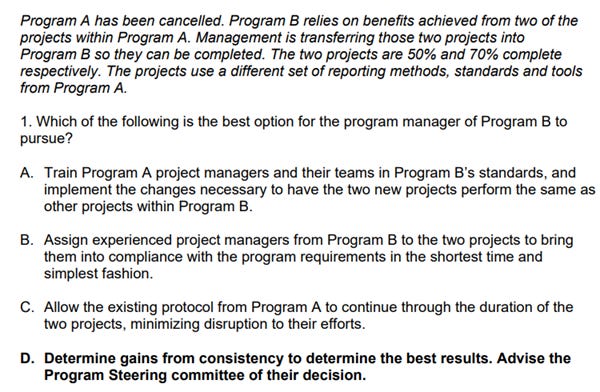
- Image taken from PMI’s “PgMP Sample Test Questions” document on 7/21/2026
In an easier world, you’d be asked questions such as “Select the correct definition of a program?” which requires rote memorization, but little application of the actual concept. In the case of a situation-based question, you need to solidly know the core content, deduce the intent of the question, and further align your judgment to PMIs. The bar is again high for the level of studying required to succeed at the test. You don’t just need to study the content; you need to learn it.
“Edge of Midnight”
So “What does it take to pass the PgMP exam?”
In assessing the 1) test, 2) content, and 3) exam questions, everything came back as “Very Difficult” on my potential scenarios spectrum. Given the size and depth of the exam, you most likely can’t crash through the SPM the week before and pass.
You will need to 1) internalize the knowledge in the SPM, 2) practice the exam questions until you excel at the format, and 3) build up your mental stamina and speed so you can actually get through the marathon-run of 170 questions.
That’s how you pass the PgMP exam.
How you tactically achieve all this depends on many other factors such as learning style, financial resources, time, motivation, etc. Know that there’s no one best path to preparing for the exam, and you’ll have to find the approach that works best for you.
But to help out, I’ll tell you how I did it next time on “The Non-Profit Program.”
For this article’s song pairing, I give you “Edge of Midnight” covered by Miley Cyrus and featuring Stevie Nicks. While I’m no white-winged dove, the song reminds me of all the independence and internal grit you’ll need to get through the study process for the PgMP exam.
References
PgMP ® Program Management Professional (PgMP) ® Handbook Contents [Internet]. [cited 2026 Jun 11]. Available from: https://www.pmi.org/-/media/pmi/documents/public/pdf/certifications/program-management-professional-handbook.pdf?rev=d0f4f6474e9d4c07b8b9bb8786303973
Program Management Professional (PgMP) ® Examination Content Outline (ECO) [Internet]. 2024 [cited 2026 July 21]. Available from: https://www.pmi.org/-/media/pmi/documents/public/pdf/certifications/pgmp-exam-content-outline-english.pdf?rev=74f6af64c47f40e183f13743603851d5
Project Management Institute PMI. The Standard for Program Management - Fifth Edition. Project Management Institute; 2024.
The new PMI standard for program management [Internet]. Pmi.org. 2024 [cited 2026 July 23]. Available from: https://www.pmi.org/learning/library/new-pmi-standard-pm-8179
Disclosure: In writing this series, I am not employed or compensated by PMI in any way. My affiliation with PMI is solely as a member and PgMP certificate holder. The experiences and opinions included here are my own.