


Imagine running a program and having a best friend there to help. What would you wish for?
A knowledgeable sounding board to talk through your program’s challenges.
An expert in program management to guide you on everything needed to build a fantastic program.
A backup who shares and bears some of the mental workload of tracking progress.
A resource that knows how to set up a snappy decision tree that gets your program moving and helps you work more effectively with leadership.
An advocate who can provide backup when bad news needs to be communicated and difficult decisions need to be made.
This best friend can be a “Program Management Office” (PgMO): a program management expert(s) who is there to support you.
Where are all these PgMOs?
But alas, this resource is far from ordinary. In the non-profit industry, while Project Management Offices (PMOs) are common, I’ve never observed the existence of a dedicated PgMO, much less one that functions in the way specified by the Project Management Institute (PMI) – more on this unique take later.
Based on my experience working in Boston (United States), I assume that PgMOs are rarely used in the non-profit industry. However, in researching PgMOs, I’ve found their worth deserves stronger consideration.
Particularly as non-profits work to untangle society’s most intractable problems, we need to improve our ability to run effective programs. That lift cannot be borne by program management professionals (PgMPs*) alone in their silos across the workforce. A PgMO can provide a centralized touchpoint and necessary guidance to help PgMPs master their complex discipline, ensuring that tough programs ultimately succeed in realizing their benefits.
*In “The Non-Profit Program,” I use the term program management professional with the acronym PgMP to refer to anyone working or interested in program management, regardless of their official job title or credentials. This usage differs from the typical professional usage, where PgMP indicates the successful completion of the Program Management Professional certification offered through the Project Management Institute (PMI).
PgMO structure
In formulation, a PgMO (1, p. 26-27, 122) can have many different setups and sizes broken down across two categories:
Enterprise-wide PgMO: These PgMOs are large, centralized management structures. In this setup, the enterprise-wide PgMO assumes responsibility for enhancing the maturity of program management across the organization. They set the standards for program management and assign officers to individual programs as guides and supports. These organizations also provide training to the broader program management workforce (or aspiring employees, such as project managers and coordinators). While PgMOs can stand as an independent office, you may have a PgMO under the umbrella of a broader project management organization (PMO) or portfolio management organization (PfMO).
Program-specific PgMO: This is a PgMO created for an individual program, in which case this PgMO becomes an internal part of the program’s infrastructure. In most circumstances, a program-specific PgMO would consist of one person or, potentially, a small group of highly experienced and expert program management professionals. They serve the same function as a PgMO officer being assigned to a program by an enterprise-wide PgMO. But unlike an enterprise-wide PgMO, this PgMO setup has no organization-wide responsibilities. They exist only to ensure that a high-quality program management methodology is implemented within that target program.
Regardless of the setup, the essential part is that when organizations engage in a PgMO, there’s a person with experience and expertise charged with ensuring that a high-quality program management methodology is used to create a successful program.
Key functions
A PgMO has two key functions according to the Standard for Program Management (1, p. 26).
Governance: The PgMO establishes the governance structure for a program, essentially setting up the leadership structure and the protocol for making decisions. The hope is that the PgMO is introducing a governance structure commonly used across the organization and then helps the program sponsor and/or program manager (if assigned yet) adapt that plan to the program’s specific circumstances. In this way, a PgMO gets a program through its first highly technical, detailed step.
Methodology: As the program proceeds, the PgMO serves as a teacher, coach, and monitor to the program manager, ensuring that core practices of program management are implemented. Given the sheer number of plans, logs, and registers to maintain as recommended by the PMI (stakeholder registry, benefits management plan, risk register, change log, and the list goes on), it’s only human to let these items slip if no one else is reading them. The PgMO provides an accountability partner to keep up with the essential, but non-urgent work. Furthermore, everyone needs feedback. It’s not necessarily an appropriate use of a program’s sponsors’ or steering committee members’ time to conduct a detailed review of every program document. A PgMO can be that essential reviewer, freeing up the program leadership’s time for higher-value activities.
Throughout the program’s lifecycle, an essential component is that the assigned PgMO officer and the program manager establish a strong, trusting relationship. Those ingredients will trickle down to the project staff, allowing an entire program team to navigate the most formidable challenges in a program’s evolution: an inevitability for a long-running program tackling a complex societal problem.
PgMO’s quirky authority
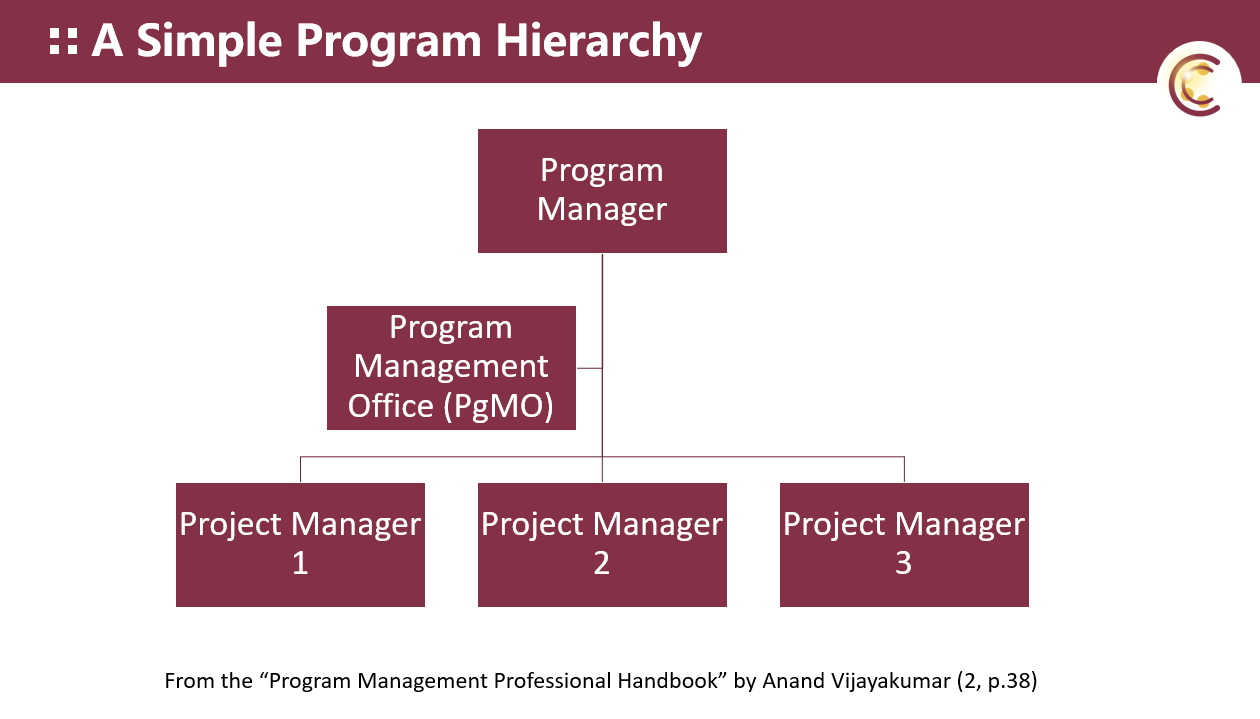
A fun fact about a program-specific PgMO or PgMO officer assigned to a program is that their authority is not top-down. As an “Office”, one may intuit that the PgMO has direct jurisdiction over the program manager, but that is not the case. According to the PMI, the PgMO sits below the program manager and above the project managers in a program’s hierarchy. This genuinely surprised me and took a minute to understand.
The placement truly speaks to the PgMO’s unique role as a coach, mentor, and reviewer in the implementation of a program. Furthermore, it reinforces the program manager’s authority over their own program, with the PgMO holding no formal decision-making power over the program’s trajectory. That’s ultimately between the program manager and their steering committee.
Field experience: “Growing up” without a PgMO
With the rules of the road laid out for what a PgMO is about, I’ve admittedly never worked for an organization that maintained a dedicated PgMO nor supported the functions of one within a broader PMO or PfMO umbrella. I learned how to manage programs through lived experience, but in twenty-twenty hindsight, I see plenty of ways a PgMO would have helped my work and my career thrive.
My experiences with PMOs and learning program management
As a consultant at a mid-sized firm early in my career, a project management office (PMO) was established in my last year with the company. Unfortunately, its benefits did not reach me before I left the organization. I then arrived at Boston Children’s Hospital to run the Integrated Care Program. I was happily included in their PMO’s regular reporting meetings and provided training in Six Sigma methodology. It was incredibly helpful in enhancing my project management skills during those initial years. Still, the material never directly addressed the complex task of integrating projects over a long period of time to achieve a broader benefit (i.e., program management). After I had worked through what the PMO offered in project management training, my relationship with the PMO ultimately trailed off as they had no direct responsibilities to my program.
In my experience, the discipline of program management was learned through field experience. I observed and supported senior staff. Along the way, I picked up their methodologies and techniques for managing stakeholders and mitigating risk (even if we didn’t use that terminology). No one was certified in program management, nor did they view the work necessarily as a dedicated discipline in which to seek out advanced skills and techniques.
My informal PgMO was the program sponsor who was highly involved in the daily operations of the program, had the time to train me, but was also limited as a practitioner based on lived experience, not learned methodology. There were gaps that neither he nor I knew. Now, in retrospect, I can see where our program failed to evolve to changing market dynamics or successfully track well-defined program benefits. Aspects that ultimately capped the Integrated Care Program’s potential.
I’m confident that a formal PgMO would have been a boon in my career and helped my program reach greater heights. In supporting the evolution of the non-profit industry’s program management workforce, this is a feature of the sector that I hope to change.
A call for PgMOs
In educating myself on PgMOs, my key takeaways are that PgMOs acknowledge the complexity of program management as a job and that the absence of PgMOs at non-profits may reflect an underestimation of the training and education required to run successful programs.
For organizations seeking better results from their programs, look beyond trainings (although education is always a boon) and consider establishing a PgMO to support your program management workforce.
For program management professionals running complex programs, please know that going it alone may be typical, but it should not be the standard. Even if you don’t have access to a formal PgMO, look for ways that your leadership, team members, and even online professional forums, such as those hosted by PMI, can fill the role. Consider asking an adept project manager to review your risk registry for feedback. Set up with a trusted mentor or steering committee member to be a sounding board for program-related challenges. Post questions to PMI’s online forums to check your assumptions on methodology. Based on the literature, the bar for support should be far higher than the currently available. While the industry catches up, be proactive in securing these resources for yourself. Recognize that a coach, mentor, and reviewer are essential, not just nice to have, for running successful programs.
“For Good”
This week’s song pairing is “For Good” from the musical “Wicked”. Yes, I’m excited about the upcoming release of the new film in November! It is a perfect song for conveying the value of a strong partnership — one that requires both friendship and differing perspectives. Here is the original Broadway cast’s version with Kristin Chenoweth and Idina Menzel. I’ll be sure to return and post the movie’s version when it is released.
References
Project Management Institute PMI. The Standard for Program Management - Fifth Edition. Project Management Institute; 2024.
Vijayakumar A. Program Management Professional (PgMP) Handbook 2nd Edition. Notion Press; 2025.
I find the concept of positioning a Program Management Office under a single Program Manager to be outdated. In my view, a Program Management Office should be a team comprising all project managers, platform architects, and project management methodology experts. Their primary role should be to structure programs effectively, balance resources, and conduct professional multi-program management—helping with smart prioritization when plans deviate or resource bottlenecks occur. Projects shouldn't be running so poorly that you need a Program Management Office to solve the problems that projects create for each other in the first place.