


In my last article, I promised to write about the application process for the Program Management Professional (PgMP) certification. Unfortunately, the background research is taking longer than expected, and I need to delay that topic until the next publication cycle.
In the meantime, let’s tackle another BIG decision you need to make early on in your PgMP journey: boot camp.
Does anyone remember that scene in “Good Will Hunting” where Will (Matt Damon’s character) lands a mic-dropping one-liner on a rival male about getting a Harvard education simply through reading?
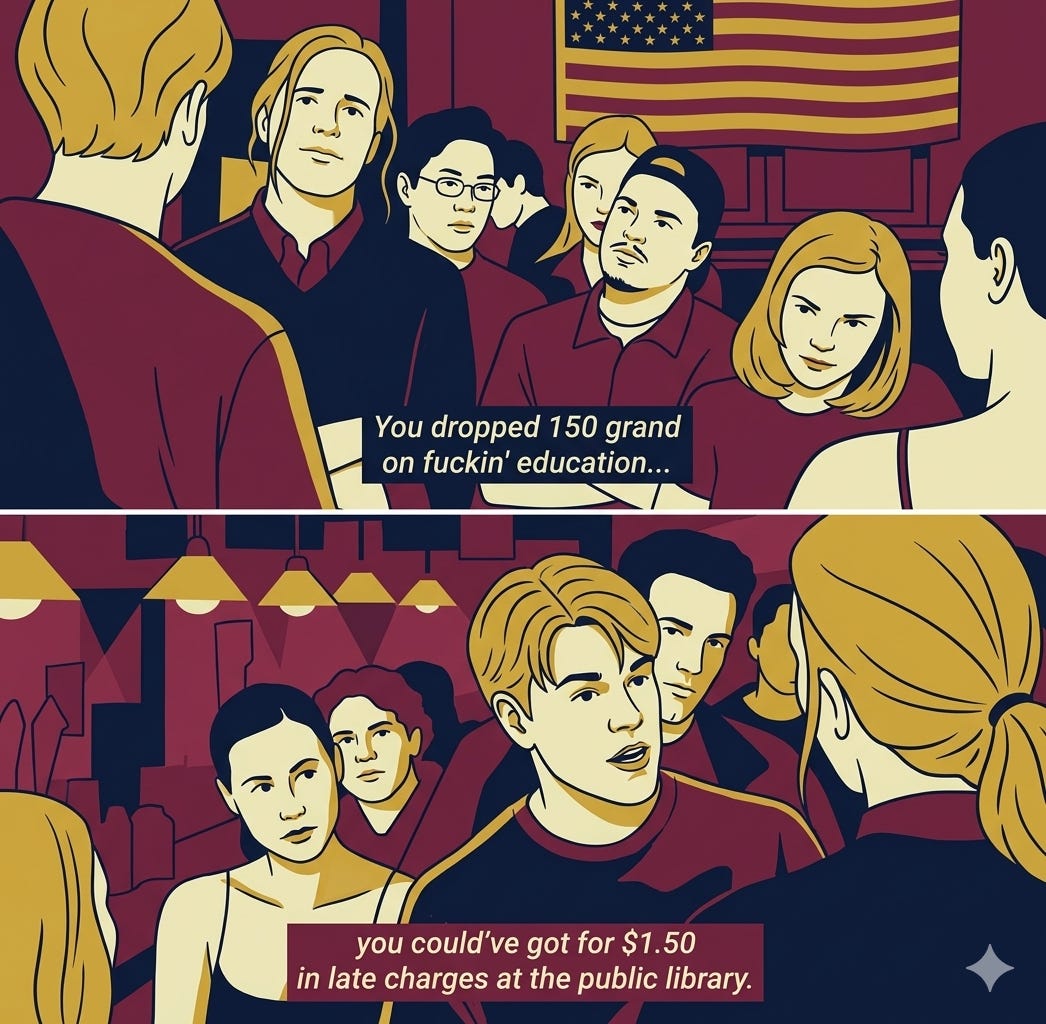
The line is a zinger with an intriguing point. How much can you learn and save if you’re willing to hit the books?
While the COVID-19 pandemic clearly demonstrated that society is unwilling to abandon structured group learning experiences in favor of self-study, the question remains valid in the specific case of the PgMP certification. Can you pass both the application and exam without structured training? If so, what factors should you consider when deciding whether or not to spend your time and money on a PgMP boot camp?
Sidebar: How have those “Good Will Hunting” statistics aged over the past thirty years? Well, a Harvard undergrad degree now costs you ~$380k, which is ~$90k above that 1997 price adjusted for inflation (what a deal!). But on the bright side, both the Boston and Cambridge public library systems are now fine-free, so Will would have saved himself the $1.50. 😊
About the “Project PgMP Certification” Series
In this series, I share my journey toward PgMP certification, including my experiences with the application, educational materials, and exam. If you are considering the PgMP certification or curious about a mid-career educational adventure, this series is for you. This post, Part 3, focuses on the option of attending a PgMP boot camp and what factors to consider before spending time and money on structured training. Also, while I strive to include accurate details about the PgMP certification, please refer to the Project Management Institute as the final authority on all requirements and processes.
What are PgMP boot camps?
PgMP boot camps are structured trainings designed to rapidly teach the core concepts in PMI’s “The Standard for Program Management” (1) and prepare students to succeed on the application and exam. They are referred to as “boot camps” because they are often held over three to four consecutive days, requiring eight hours of training each day.
PMI does not offer these boot camps directly; instead, it hosts an “Authorized Trainer Partner Program” to oversee the trainer marketplace (you can search for authorized training partners in your area here). Of course, this boot camp approach is not limited to the PgMP, but offered across the PMI certifications, with the most popular being the Project Management Professional (PMP) certification. They range from in-person to online, live or asynchronous, and cost between $1k – $3k+. While books, podcasts, YouTube videos, and e-courses exist – we’ll talk about those later – the boot camp is probably the most common structured educational route for those pursuing a PMI certification.
Sidebar: For those familiar with the PMP certification requirements, PMI requires 35 contact hours of formal project management education to apply for the PMP exam, which further incentivizes people to pursue formal trainings such as boot camps. In contrast, the PgMP has no such requirement, leaving the candidate to pursue formal education at their own discretion.
Does everyone attend a boot camp?
As training organizations are highly dispersed across the globe, there’s no single tally of how many people are attending boot camps for PMI certifications. Further, for the self-study cohort, we have no information on the size of this group or how many people drop out midway through their studies.
I did ask Google’s Gemini (AI) platform how many people have attended boot camps for PMI certifications, and it estimates that 30-40% have attended boot camps for the PMP certification. When asked for its source on that number, Gemini doesn’t provide a clear citation or rationale for the estimate, so please take that data point with one MASSIVE grain of salt. What it did point me to is that project management training organizations list hundreds of thousands of alumni on their websites. See this example from the “Project Management Academy” (2).
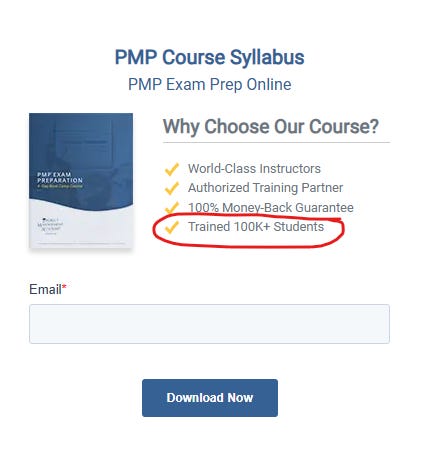
I do believe people are engaging in these boot camps in large numbers, but it doesn’t account for everyone taking the exams. My hypothesis is that there are sizable cohorts in both the boot camp and self-study buckets.
For me, I started my PgMP journey by deciding to forgo a boot camp unless absolutely necessary. This decision was driven by my personal circumstances, not by any dislike of professional training (i.e., if someone had offered to pay, I would have gone gladly). I can personally attest that I completed the certification process through self-study, passing both the application and the test. But the self-study route is a hard path to trod, and there are considerations to think through when deciding which road is best for you.
Should you PgMP boot camp?
Honestly, if your employer is willing to pay for it, then say “thank you very much” and take the win. Accept help when it is given; no need to think more deeply. But if you are paying for training, its necessity is worth a closer look. Here’s my personal considerations that led me down the self-study route.
Finances
One year ago, I was starting my own business, having said goodbye to the 9-5 job with its fancy training perks. While I had money set aside for professional development, every dollar mattered, and if I didn’t absolutely need to spend it, then I was open to taking the harder path.
Time
What I did have by becoming a solopreneur was control over my own time, and I could dedicate my “strong-brain” hours in the middle of the day to learning the SPM. Certainly, if I were managing an all-consuming program full-time during business hours and only studying at night after the kids had gone to bed, my calculus for speeding up the process would have been quite different.
Personal learning style
One of my strongest academic qualities is “grit” or an extreme tolerance for the slow trudge through even the driest materials. What I’ve always lacked in academic speed, agility, and memorization, I made up for with sheer hours of study during high school and college. Upfront, I knew the PMI material would be both challenging and dry, but I was confident in my ability to get through it without needing external monitoring. For most anything else in my life, I need that accountable partner, but not this.
Educational goals
Beyond cost, my second-greatest reason for choosing self-study was the opportunity to draw my own conclusions about the material. As I mentioned in Part 1: Why I Pursued a PgMP Certification, I was a couple of years out from leaving a failed, but much-loved program. The situation continued to befuddle me: how could my colleagues and I be trained at the best healthcare schools and hospitals in the country, yet still see a much-needed program slip into unfixable, steady decline?
In my post-mortem, I recognized a broader business problem underlying my experiences: a need to advance the program management discipline, particularly by adapting current techniques to the quirks of the non-profit industry. At that moment, I wanted as much room as possible for my own independent thought to hammer out a better way to manage non-profit programs. I chose to shut out the input from teachers and fellow students, opting - likely for the first time in my life - to truly be alone with my thoughts on a prominent question.
Should a boot camp be a part of your PgMP journey?
Remember that at the end of any PMI certification journey, there’s no extra points awarded for how you got there. If you are considering how to tackle the PgMP or a similar educational endeavor, a boot camp can be a great way to make progress. The key takeaway here is that while an expensive educational training can be extremely useful, it is not 100% needed. You can approach the PgMP through dedicated self-study and come out successful at the end.
Looking ahead, I predict that educational options for the PgMP and related certification programs will continue to expand as the proliferation of podcasts, e-courses, apps, and similar resources grows. Your training options will be vast, likely offering lower-cost options but also new challenges, including too many choices and difficulty gauging quality.
In your own PgMP journey, remember to think about your unique situation: finances, time, personal learning style, and underlying educational goals. Those needs will be the best guides for where to spend your money to support your PgMP journey.
Honoring my callout of “Good Will Hunting,” this week’s song pairing is the leading number from the film: “Miss Misery” by Elliott Smith.
P.S. If you’ve taken a PgMP boot camp and are open to sharing your story, write me. I’d be interested in learning how it went.
References
Project Management Institute PMI. The Standard for Program Management - Fifth Edition. Project Management Institute; 2024.
Project Management Training | Project Management Academy [Internet]. projectmanagementacademy.net. Available from: https://projectmanagementacademy.net
Disclosure: In writing this series, I am not employed or compensated by PMI in any way. My affiliation with the PMI is solely as a member and PgMP certificate holder. The experiences and opinions included here are my own.