


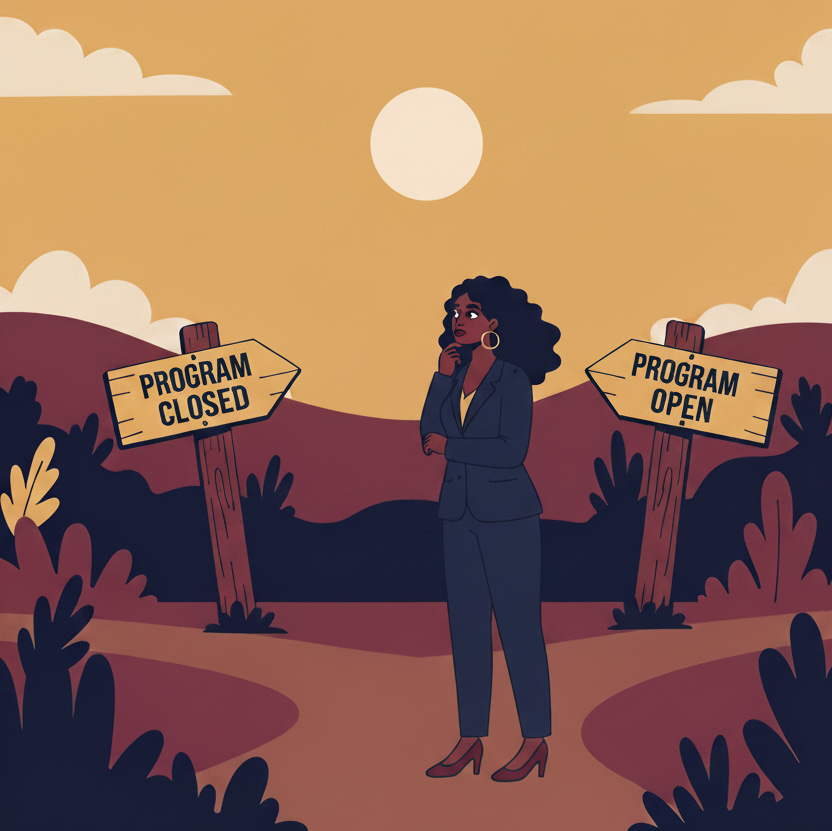
If your program ends, does it mean you failed?
Absolutely not.
In fact, your program is supposed to end. Possible reasons for closure do include failure, budget cuts, and strategic realignment, but your program can also close because you succeeded.
In the non-profit sector, the dreaded program closure is much feared because your job is often directly tied to your program’s existence. To end your program is to justify the loss of your livelihood, professional community, and thought leadership platform. With such significant deterrents in play, program closure isn’t something you’d ever aim for intentionally.
But according to the Project Management Institute (PMI), program closure is a desired and healthy part of a program’s lifecycle(1). Their guidance specifies that PgMPs* should aim for a formal program closure, transitioning program activities to operations for ongoing sustainment and benefit realization.
So, how should we parse these two different versions of a program’s lifecycle?
About the “Finding Your Finish Line” series
This past summer, I wrote the “The Great Uncertainty” series, five articles focused on navigating the prospect of program cancellation for PgMPs affected by the federal funding cuts.
This series is meant to explore the other half of that closure coin—how do we intentionally manage our programs toward a favorable ending? In studying PMI’s Standard for Program Management (SPM), I found a significant difference between PMI’s guidance on program closure and my field experience, suggesting that positive program closure remains a bit of a mystery for non-profits. This article, Part 1, begins with my assumptions on why non-profits build such long-tenured programs.
PMI’s guidance on program closure
According to the Standard for Program Management (SPM), programs have a lifecycle broadly captured in the 1) Definition, 2) Delivery, and 3) Closure phases. The intention is that every program is built to achieve a set of intended benefits and then transitioned to “Operations” for ongoing sustainment (1, p.13, 140-149).
For example, your company is running “a global IT modernization program” or “multi-phase technology upgrade” (2). As the PgMP, you then work under the assumption that once the new tech is installed, it becomes part of the company’s regular activities, shifting maintenance to the purview of day-to-day management. Admittedly, such programs are framed as short, contained, and well-defined.
The literature offers only a slight nod to program lifecycle ambiguity, noting that some programs can persist for decades before closure (1, p.34, 141). So far, I’ve not found any further specification from PMI on what factors create long-term programs.
Field Experience: Projects end, not programs
As I’ve studied PMI’s approach to program management, that concrete definition of program closure surprised me because it was so antithetical to my professional experience.
In my work, it was always projects that had beginnings, middles, and ends. Goals are achieved, the team raises a glass to success, and then moves on to the next project. Programs were set up to be ongoing, and their termination only meant something bad had happened.
What drives never-ending programs at non-profits?
In considering this conflict between guidance and experience, I can point to three significant factors that support the long-tenured program structure that commonly exists across many non-profits.
Non-profit benefits are lifelong ambitions.
Often in non-profits, the intended program benefits are directed toward an almost ethereal goal—solve hunger, stop disease, improve childhood literacy, prevent suicide, etc. These goals are what make programs an ideal vehicle for non-profits in the first place. Programs are focused on delivering benefits. These goals are the benefits.
These big goals also result in the program’s continuous nature. I don’t imagine we’ll cure all forms of breast cancer in my lifetime. Therefore, if you run a program advocating for the cure to breast cancer, you’ll always be onward and upward to the next project in your work. That cycle has no purposeful reason to end because while you’re making headway on the problem, it still persists.
Many non-profit programs are frontline, self-sustaining vehicles.
After reading PMI’s literature, I conclude that the guidance is intended for programs designed to improve an organization’s underlying operations. I call these “Backline Programs.” Examples include installing a new Enterprise Resource Planning (ERP) system, building a new mass transit system, etc (2). These are the programs that have a clear end with transition to a team for ongoing operations (until the next improvement program comes around).
At non-profits, a program intended to reduce childhood drownings will focus on providing swim lessons to kids. That’s a service people are willing to pay for, which generates revenue to fund more swim lessons for the next batch of kiddos. I call these “Frontline Programs.” They are programs (and publicly named as such — see the YMCA’s Sports and Swim Programming) that also merge with operations. With ongoing revenue and a continuous customer base, these programs have no reason to close.
Non-profits lack job fluidity, discouraging PgMPs from program transition.
When I worked at Boston Children’s Hospital (BCH), I was hired as “Program Manager of Integrated Care.” In a world where I achieved the program’s goals and closed the program, continuing at the institution would have required finding, interviewing, and acquiring a completely new job. In gathering information on the career progressions of mid- to upper-level administrative management at BCH, I discovered that transitioning departments was extremely challenging and atypical. The most common career track among leaders was a direct climb through promotions within one’s department, with little change in job focus. The organizational culture was not set up to encourage PgMPs to aim for program closure in their work.
This setup is certainly not the case for all non-profits, and job fluidity—the ability to change roles—likely looks quite different across start-ups, smaller non-profits, and other industries compared to the natural rigidity of an academic medical center. Still, as non-profits tend to be academically inclined and encourage long tenures, I believe a common theme for PgMPs is that current career tracks foster deep expertise development, which creates an intense fear of losing the platform (i.e., program) where such expertise is applied.
“Closing Time”
The problem with non-profits’ tendency to build “never-ending” programs is that eventually they do end, and that downfall can be heartbreaking. Your organization’s priorities will change, recessions will come for your budget, or unforeseen emergencies will unravel the world overnight. If we design our programs around continuous work toward a nearly unachievable goal, the end of our work will inherently be a bad one…abrupt and adjacent to job loss. Minus retiring and handing the reins to a worthy successor, this setup leaves us vulnerable to only sad endings.
Conversely, as PgMPs, we may only be able to achieve our best work nestled in the safety of a long tenure. In an article titled “Non-Profit Power: 5 Years In”, I reflect on my fifth anniversary with ANHW Boston and wrote, “Over five years, you deepen your expertise and build your relationships to an intense level. Certainly one where you can deliver exceptional work, perhaps even become capable of achieving benefits that no other person on the planet can replicate.”
Non-profit PgMPs admittedly find themselves in a bind. I can make a reasonable case for supporting either program closure or program continuation as the better path. There’s clearly no single correct answer to any particular program’s ideal lifespan.
But one advancement that the non-profit industry should consider is how to incorporate program closure more positively into its program infrastructure. Setting firmer, achievable program goals and encouraging PgMPs to run new programs can provide tremendous benefits to the industry and a healthier work environment for all. We can’t get there overnight and certainly without changing the system around PgMP careers.
I’ll dive deeper into the benefits of program closure and what PgMPs need to thrive around program closure in my upcoming articles. Look for the next installation of “Finding Your Finish Line” on Wednesday, December 10th.
This week’s song pairing is a personal favorite: “Closing Time” by Semisonic. Listening to those lyrics, you’ll hear no judgment that closing is a bad thing. The bar’s done its job and helped people meet, mingle, maybe fall in love… or at least lust. Closing is simply the resolution of the evening as it progresses towards morning. Perhaps it should be the same with programs?
References
Project Management Institute PMI. The Standard for Program Management - Fifth Edition. Project Management Institute; 2024.
PMtraining [Internet]. Pmtraining.com. 2025 [cited 2025 Nov 12]. Available from: https://www.pmtraining.com/pgmp/practice-exams
*In “The Non-Profit Program,” I use the term program management professional with the acronym PgMP to refer to anyone working or interested in program management, regardless of their official job title or credentials. This usage differs from the typical professional usage, in which PgMP indicates the successful completion of the Program Management Professional (PgMP) certification offered by the Project Management Institute (PMI).
Correction (12/6/25): The publication date for the next article was updated from November 26th to December 10th. Thanksgiving🦃got in the way of my publication schedule. Gobble, gobble.