


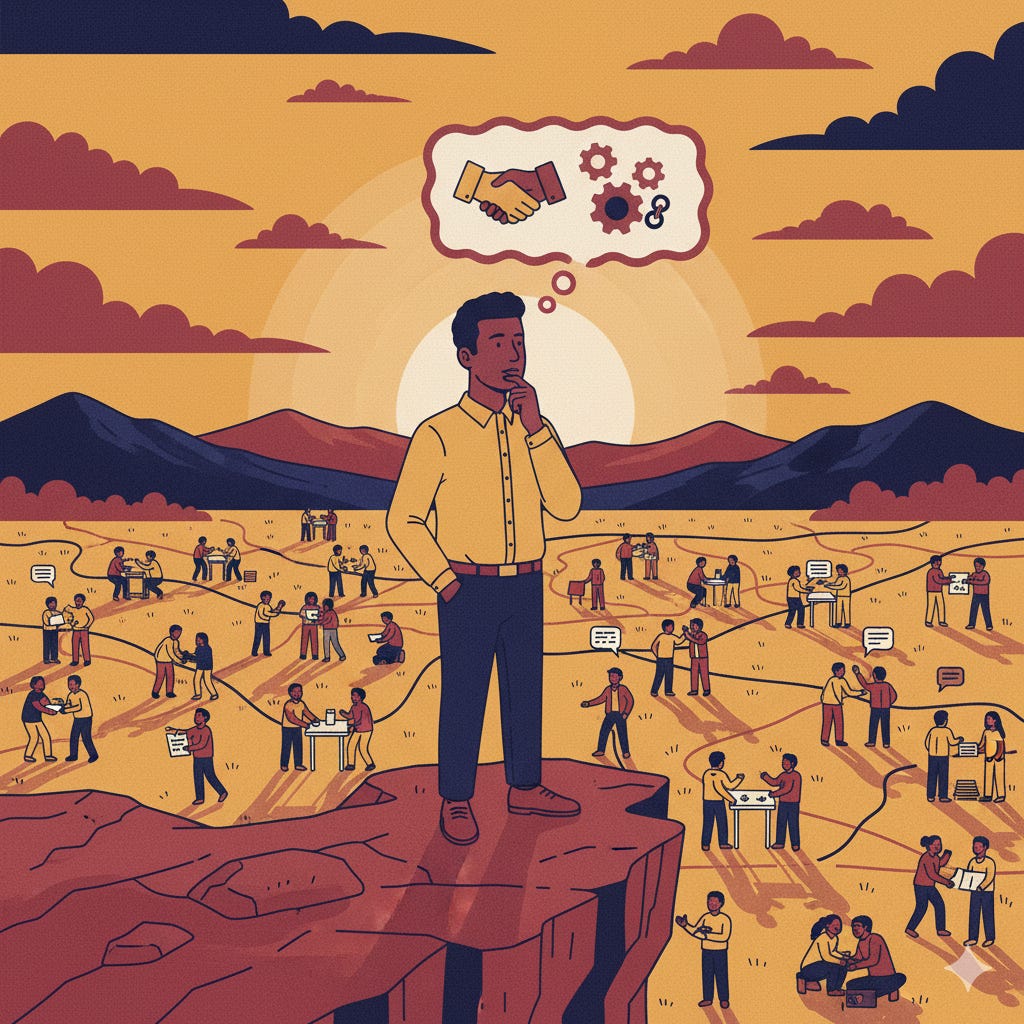
Collaboration is a big deal for programs. It represents the partnerships that can exponentially expand the impact of your work or fill in needed gaps without adding budget or staff. While joining a group together and calling out a common goal can result in harmonious teamwork, that’s no guarantee. Collaboration is absolutely a trait that can be identified, coached, and fueled, however widespread and diverse your program’s stakeholders may be.
As a program management professional (PgMP*), you are in the best position from which to identify and foster effective collaborations, leveraging your birds-eye view and deep expertise of the program. It is also the core place in your work from which to add outsized value, supporting the case for your career’s elevation.
But only if you find the right collaborations.
Let’s dive in…
*In “The Non-Profit Program,” I use the term program management professional with the acronym PgMP to refer to anyone working or interested in program management, regardless of their official job title or credentials. This usage differs from the typical professional usage, in which PgMP indicates the successful completion of the Program Management Professional (PgMP) certification offered by the Project Management Institute (PMI).
I. Understanding collaboration
Early in my career, I was a consultant at a midsize firm, and one of my clients had quite the memorable poster hanging in the conference room. It was a gorgeous photo of the Great Wall of China with the phrase “Teamwork: Many Hands, Many Minds, One Goal” underneath.

It struck me then, as it does now, of the irony in this poster. The Great Wall of China was built with forced labor. Along with 300,000 soldiers, the Qin Emperor conscripted nearly 500,000 people to build his original wall, which was completed in 211 B.C.E. (1). Along with criminals, civilians were also conscripted, where “many of these workers were forcibly dragged from their homes” (1). Tens of thousands are believed to have perished at the wall, with their bodies then used as building material. Early human history is not pretty.
While the Great Wall is nonetheless a monument to human ingenuity and a simply gorgeous creation, treating it as an exemplar of teamwork that we should aspire to is a mistake. The best of teamwork obviously can’t consist of people working under duress and risking their lives. Yet, fifteen years after I spotted this poster in that conference room, it is still for sale on office supply websites.
This is all to say that sometimes in business, we need to think more deeply about what teamwork and its sister term “collaboration” actually mean.
What is “collaboration” to program management?
Collaboration, taken from Oxford Languages (i.e., Google search), is defined as “the action of working with someone to produce or create something.” For anyone in the pro-port management universe (projects, programs, products, and portfolios), this term is essentially synonymous with our daily work. We are constantly working with people, trying to move forward on the next steps.
Collaboration beyond this daily grind for PgMPs is about finding points in the work where people and groups with different skills, knowledge, and resources can work together to achieve a far greater outcome. Through the accumulation of these achievements built on collaboration, the quality and/or quantity of your program’s benefits (i.e. how you help people) can dramatically expand.
For PgMPs newly elevated from project management, a significant shift is the increased complexity and scale of collaboration. Along with fostering a collaborative environment among your program and its related project teams, you are also keeping your head up, seeking productive partnerships with stakeholders, both internal and external to your organization. As a PgMP, you’re casting a much wider net, looking for teams, departments, or other organizations with a similar goal, but different resources.
Collaboration as a synergistic effect
While collaboration is a soft skill that can be easily discounted, it is especially important for PgMPs because it is the area where your labor can work while you sleep.
Truth be told, much of program management work is steady and incremental. If you were to start giving imaginary points to your contributions like you’re a wizardry student at Hogwarts,
· You created a program charter (10 points)
· You updated your stakeholder log (2 points)
· You identified an external risk in the resurrection of “he-who-must-not-to-be-named” (60 points… you won the House Cup!)
You monitor, log, and manage at a steady clip. For the most part, your work has a one-to-one relationship with the pacing of your program’s progress. If you let off the gas, your program will falter. If you push too hard, you lose staff to burnout.
But across the work, collaboration presents you with a golden opportunity. You are the one in every room; working, hearing, and learning from every stakeholder. From this viewpoint, you will see collaborations where others can’t. While the effort to foster a new partnership does take effort on your part, if that collaboration creates something that your program couldn’t otherwise do independently, you’ll achieve a synergistic effect with an indeterminate range (like a “Chamber of Secrets level” 200 points)!
But what does this really look like in the field? Here are two stories from my professional experiences running programs.
II. Field Experiences: Program Collaboration
Boston Children’s Hospital
At Boston Children’s Hospital (BCH), I ran the Integrated Care Program, which aimed to improve the coordination of care across a patient’s providers to achieve better health outcomes. The program team was always small (at our largest, five staffers) and a true bottom-up program, the expansion of an “idea” with absolutely no organizational mandate. While it was cool to be a startup within an academic medical center, it also meant clinic teams didn’t have to work with us.
If we had stayed to ourselves, crunching data and developing tools, we might have had some good ideas, but the program would have quickly flamed out. Our absolute greatest strength was collaboration—the ability to foster meaningful partnerships with clinical teams across the hospital and with local referring provider partners. At the height of our work in 2019, we were conducting projects with the Departments of Neurology, Gastroenterology, Genetics, and Urology, as well as with the top referring partners in the state. Further, the Chiefs and Medical Directors at these departments regularly spoke on our behalf at executive leadership meetings, adding tremendous credibility to our cause.
Through these alliances, we gained a toehold across a sizable portion of the hospital’s operations from which to work on our tools, measures, and processes for improving care integration. We may have been a small group, but our collaborations amplified our presence well beyond anything I could have achieved with 3x the project staff.
Alumnae-i Network for Harvard Women
Now, as the President of the Boston Chapter of the Alumnae-i Network for Harvard Women (ANHW), I regularly utilize the skills I learned at BCH to advance our mission: supporting women’s leadership and equity. With a volunteer steering committee, our most limited resource is time. After trialing a mentorship program ourselves, we learned how impractical it would be to run one for our group. We pivoted and joined forces with the New Girls Network (NGN), part of Big Brothers Big Sisters of Eastern Massachusetts. NGN runs a robust mentorship program for early-career women in the Boston area, with dedicated staff and the resources to support high-quality logistics.
We brought to the table mentor/mentee recruitment capabilities as well as the development of a professional educational workshop on women’s leadership. Through this collaboration, we are achieving a core goal for both our groups: supporting women’s mentorship at a scale we could not achieve on our own. For NGN, they have ANHW Boston’s enthusiastic support, a professional partner, and, where helpful, an ability to point to a Harvard-affiliated organization as an ally (I’ll throw absolutely no shade on sharing prestige branding). While still in our first year, we are seeing the benefits of women supporting women in their careers. It’s not a golden ticket to achieving gender equity across the region, but it’s undoubtedly one of those impactful ingredients.
“Ripple”
I hope these examples from my professional career bring to life how positive collaborations can dramatically advance your program’s goals and benefit your community. These were not service or contract agreements, but true collaborations built on mutual objectives and, honestly, friendship. Particularly in resource-strained non-profit organizations, these types of partnerships are the lifeblood of non-profit programs. But that is to say that not all collaborations run smoothly.
I’d be remiss not to mention that the more people you add, the more complexity you introduce, and the greater the risk you take in realizing your program’s outcomes. Further, additional stakeholders add more direct work to your plate, from simply adding to your communications plan to the larger work of maintaining alignment over time on strategic goals.
Collaboration is not an area to swing the door open and always say “yes.” Forming partnerships needs to come from an introspective space, knowing that both your goals and, frankly, your work styles are strongly aligned. From there, collaborations need to be fostered and maintained through positive relationship management. For a good resource on the factors that best support collaboration, look to The Project Management Institute’s (PMI’s) Standard for Program Management (SPM) (2). In the most recent edition, PMI brings “Collaboration” into the spotlight as its own performance domain (i.e., big category in a PgMP’s workload) and gives solid advice on factors that impact collaboration’s success, such as engagement, alignment, transparency, etc.
Finally, for PgMPs building a case for your promotion or raise, make sure to point to your contributions to identifying, building, and maintaining collaborations. They are the value you bring that resonates much past your day-to-day deliverables. Collaborations are your RIPPLES!
On that word, I’ll share this article’s song pairing. Yes, it’s really not Christmastime, and I wish I had a Halloween song for you, but what came to the surface for this article was “Ripple” from the movie Spirited. Sung by Will Ferrell and the movie’s ensemble, it’s an incredibly accurate descriptor of how one change can multiply to a greater common good.
P.S. I have a second - very different - song pairing for this article because Da-Da-Dum Dadada-Dum Da-Da-Da-Dum Dadada-Dum. Ice Ice Baby, alright, stop, COLLABORATE, and listen.” This silly, silly song has that nice juicy business term, Collaborate, right at the start. Caveat that as a teacher of program management, I have to encourage everyone to listen before they collaborate and certainly don’t STOP first. The 90s were weird.
References
Building the Great Wall of China | Research Starters | EBSCO Research [Internet]. EBSCO. 2022. Available from: https://www.ebsco.com/research-starters/history/building-great-wall-china
Project Management Institute PMI. The Standard for Program Management - Fifth Edition. Project Management Institute; 2024.