


In two months, I’ll be at my one-year anniversary writing this Substack. It doesn’t go unnoticed that 14,458 of my 33,096 words [43.7%] published to date have centered on the topic of program closure. So, “Call me Ishmael,” this phase in a program’s lifecycle is clearly my white whale (1).
But why?
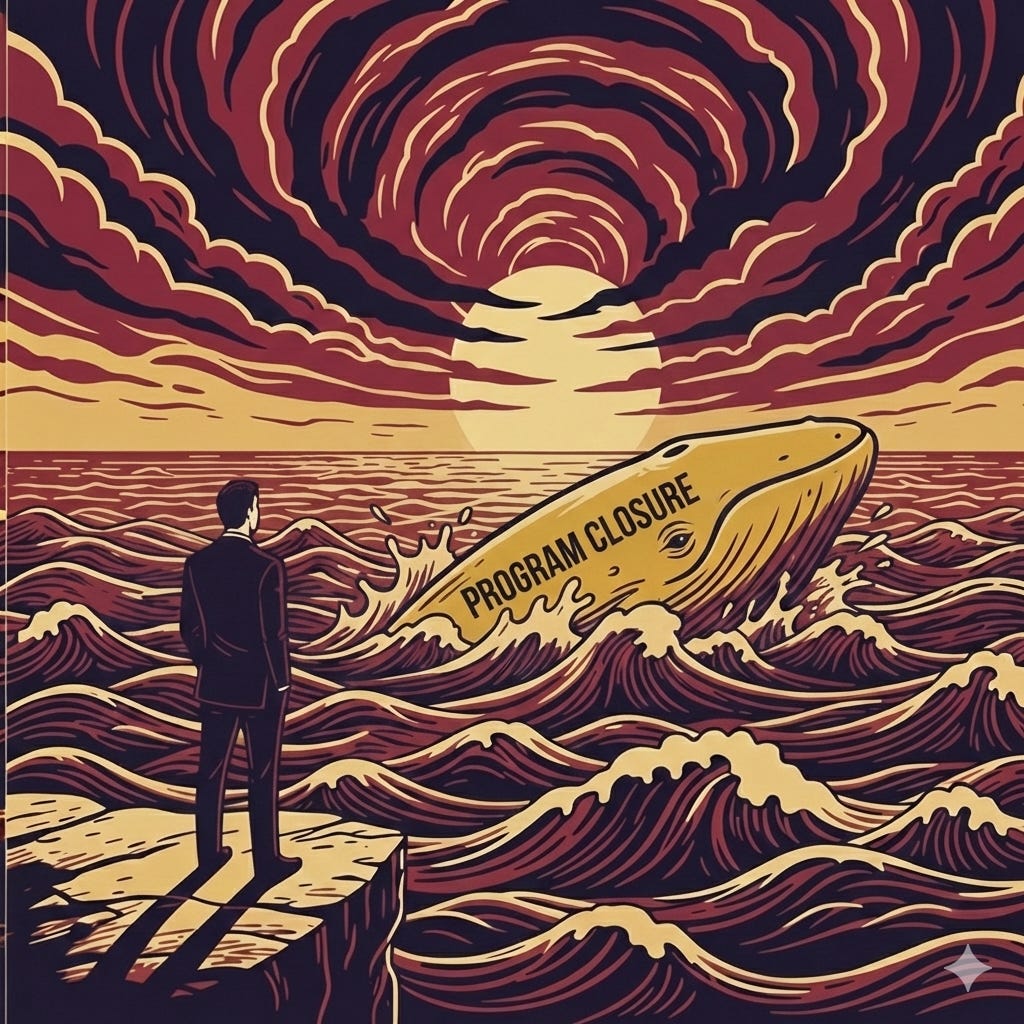
In reflection, positive program closure is elusive – at least to me – and, based on my professional experience, not commonly incorporated into non-profit programs’ structures. Since non-profit program management is often rooted in professional passion as well as the need to make a living, it makes sense that program management professionals (PgMPs*) wouldn’t naturally aim for closure. On its face, it is extremely threatening to open the door and invite in change… to your team, your subject-matter expertise, and potentially even your job.
Thus, at the start of this series, I wasn’t entirely convinced that the Project Management Institute’s (PMI’s) advice on program lifecycle was correct (2), that all programs should have a closure phase. But looking at the benefits, I am now fairly certain that working towards a program close - one that transitions work to standing operations - is necessary for building both healthy programs and program management careers.
Specifically, it was the support program closure brings to 1) effective decision-making, 2) strategy-implementation alignment, and 3) career management that persuaded me. What do you think?
About the “Finding Your Finish Line” series
This past summer, I wrote the “The Great Uncertainty” series, five articles focused on navigating the prospect of program cancellation for PgMPs affected by the federal funding cuts.
This series is meant to explore the other half of that closure coin— why and how do we intentionally manage our programs toward a favorable ending? In studying the PMI’s Standard for Program Management (SPM), I found a significant difference between PMI’s guidance on program closure and my field experience, suggesting that “positive program closure” remains somewhat of a mystery for non-profits. This article, Part 4, dives into the benefits of incorporating a program closure into your program’s design.
Benefit 1: Clarity for decision-making
A piece of business advice that I read recently on the value of defining an end comes from Jenn Donovan, author of Small Town, Big Impact. She writes that her “best piece of business advice” is to “start with the end in mind,” sharing a story from her own retail days. After buying a “rundown retail business” with her best friend, they agreed early on that this was not intended to be their forever job and set a goal to sell the business in seven years.
In her own words, “It was the best decision we ever made. Literally for the following seven years, everything we did we did with this in mind – to sell in seven years. Thinking about getting a new product line in? Would it help us sell the business? Ad in the local newspaper - would it help us sell the business? Moving to a different location (which we did twice) – would it help us sell the business?” (3, p.23).
Jenn Donovan sold that business in six and a half years, crediting that early conversation with her partner for their eventual success. In a similar way, defining the end state for a program can bring clarity to the innumerable decisions you’ll need to make along the way. Particularly as non-profit programs often focus on undefeatable social needs (e.g., cure cancer, end homelessness), the program’s mission is a bad goal to make decisions from. It’s too easy to get tangled in all the ways you could address the problem, and even with success, you’ll never actually be done. Setting a realistic end goal for your program gives you a firm framework from which to manage your program, not just ride along with it.
To apply this concept to non-profits, here’s another example. Say you are running a program to fight food insecurity and you develop a program closure goal to establish a community resource that improves residents' access to nutritious food. You may not know what that resource will be yet (food pantry, education, advocacy, etc.), but you know that you’re building towards a single, high-quality resource. The next few years then become about researching and testing different approaches, as well as finding partners in the work. Slowly, the design for your program will form, but every step along the way, you know what you're aiming for.
Now as new opportunities come up, you have that same filter that Jenn Donovan described to help make go/no-go decisions. A partner looking to provide child care services to a similar customer-base reaches out. Does it help craft that food security resource? No, and you pass with confidence. A team member wants to develop a website focused on locations where people can buy locally grown food. Does it align with the development of that resource? Maybe so you run a trial. That willingness to commit to an end vision, even if the tactics are unknown, will eliminate distractions, streamline decision-making, and provide the clarity your team needs to do their most effective work.
Benefit 2: Testing the strategy-implementation gap
Another key benefit of designing a closure phase into your program is to test the waters between your leadership’s strategic vision and your implementation plans.
A top leadership concern is the ability to translate strategy into action, often referred to as the strategy-execution or strategy-implementation gap. That gap can be quite problematic with McKinsey finding in their 2021 Global Survey that about 70% of large-scale transformations fail with poor execution and inability to sustain the effort, cited as leading causes (4). There’s now a sizable amount of business literature dedicated to helping leaders successfully translate strategy into execution (5).
As a PgMP, your program is often the vehicle through which strategy is actualized, and you play an important role in minimizing the strategy-implementation gap. Designing a program close is a great way to move beyond generic leadership conversations and rigorously test whether your plans actually align with their strategic vision.
Going back to our food insecurity example, rather than speaking to the social goal “decreasing food insecurity,” your ability to define the terms under which a program will enter its closure phase will give leadership the material needed to provide constructive feedback. “Yes, we want a resource built out that provides food to those in need,” or… given the reality you now specified, “no, that’s not the right move for our organization at this time.”
Incorporating program closure criteria at the start of a program drives constructive conversations while simultaneously deepening leadership’s accountability for standing behind the program. You’ll find that as a program ages, fairweather leadership can grow fickle, perhaps walking back their initial support for the program when times get tough. Documenting an agreed-upon program close helps ensure that you and your leadership remain on the same page, even as the larger business evolves.
Benefit 3: Positively forcing a career checkpoint
Which brings us to the third and most personal benefit of a program close. While the change that comes along with program closure can be unnerving, it also brings the prospect of new opportunities. Program closure puts needed pressure on both you and your leadership to make important decisions about your career trajectory.
If program closure is not incorporated into your program’s design, you are inherently set up to lead it until either your leadership or you take the initiative to leave – often a situation driven by negative circumstances. There’s no organic checkpoint for you and your leadership to reflect on how the business and your own skill set have evolved, and where you would be most valuable to the organization over time.
If programs have a close (coupled with closure phase activities), it triggers an organic moment for such an evaluation. The benefits to your career include:
Ideally, with success under your belt, management will shift you to a higher-priority, more visible program with a larger team, budget, and salary.
The process of conducting a closure can help you relieve the feelings and, perhaps, the social stigma of abandoning your team and leaving work unfinished.
With the prospect of needing to shift programs on the horizon, you’ll have needed incentives for carving out time for networking and professional development.
Your leadership will equally have more reason to support requests for conferences and professional development that exceed the demands of your current work.
If you are well settled into your program and enjoying building your expertise and reputation in a niche area, you’ll have a timeline in place to prepare for taking on the operational role of running the program post-closure and a framework for approaching your leadership about the role change.
It’s often too easy to get comfortable leading a program, settle in, and see where the winds take you. An expected program close creates an environment that fuels professional advancement and adaptability, ensuring you have a healthy career at your organization, and the skills and network at the ready if you do need to change jobs
“We’ll Meet Again”
In approaching this series and my deeper dives into the business management theory behind program management, I honestly questioned the need for program closure. It came up as a pretty radical idea compared to how I was trained in program management earlier in my career. Yet, as I dove deeper into what program closure really means for the work (i.e., a transition, not an end), I found it to be a solid tool for encouraging the healthy and successful development of both programs and program management careers.
If you are interested in continuing to develop your skills around ending work, two business books I highly recommend are:
The No Club: Putting a Stop to Women’s Dead-End Work by Linda Babcock, Brenda Peyser, Lise Vesterlund, and Laurie Weingart: Alongside its exploration of barriers to women's advancement in the workplace, the book delves into techniques for learning to end or transition out of work, useful advice regardless of your gender.
Quit: The Power of Knowing When to Walk Away by Annie Duke: A famous poker player, the author has since applied herself to unpacking business management, and in this book, tackles when to stop. It’s filled with guidance on ending work from an economics-informed perspective and contains many great examples of work gone too far, including what seems to be a large number of economists who go on treacherous mountain hikes and blow past their turnaround point, despite knowing far better.
While neither novel is directly about program management, they’ll push you to consider how to close off work effectively. Working on your own skill set in this regard will be helpful to your development as a PgMP, but admittedly, if you're not in an organizational culture that embraces “program closure,” you’ll only get so far. Thus, the next installment of this series will focus on the systems needed to fuel program closure at organizations.
Finally, for this article, my recommended song pairing is an earworm “We’ll Meet Again” by The Fat Rat and Laura Brehm. It’s a great mash-up of violin and techno, with positive lyrics about the continued connection between two people who are now separated. As personal connections are often the hardest to lose when we close down work, this brings a positive spin to considering those changing relationships.
References
Melville H. Moby Dick. New York, Ny: Acclaim Books; 1997.
Project Management Institute PMI. The Standard for Program Management - Fifth Edition. Project Management Institute; 2024.
Donovan J. Small Town Big Impact. 2023.
McKinsey. Common pitfalls in transformations: A conversation with Jon Garcia | McKinsey [Internet]. www.mckinsey.com. 2022. Available from: https://www.mckinsey.com/capabilities/transformation/our-insights/common-pitfalls-in-transformations-a-conversation-with-jon-garcia
Strategy execution [Internet]. Hbr.org. 2025. Available from: https://hbr.org/topic/subject/strategy-execution
*In “The Non-Profit Program,” I use the term program management professional with the acronym PgMP to refer to anyone working or interested in program management, regardless of their official job title or credentials. This usage differs from the typical professional usage, in which PgMP indicates the successful completion of the Program Management Professional (PgMP) certification offered by the Project Management Institute (PMI).