


“If you want something you’ve never had, you must be willing to do something you’ve never done.” – Anonymous*
In the last article, I shared my goal to find a better way to manage non-profit programs. Having reached saturation with the teachings of my professional community, I knew that finding whatever “IT” is would come from outside my norm. With the opportunity to pursue a new educational venture, I decided to tackle the Program Management Professional (PgMP) certificate offered by the Project Management Institute (PMI).
Statistically, you are most likely to know the PMI through its most popular certification, the Project Management Professional (PMP). That’s not an accident. There are 1.68 million PMPs worldwide (1). You are far less likely to know about their other certification programs – for comparison, there’s only ~7,000 PgMPs worldwide (2). I was in that boat a year ago and certainly had no sense of the organization as a whole nor its distinct offerings.
So, why pursue this particular certificate from this organization? Here’s my rundown of PMI and the PgMP certification, as well as how it fits my admittedly loosely formed selection criteria.
*This quote is commonly misattributed to Thomas Jefferson (3rd President of the United States of America) (3). Despite the quotes’ unknown origins, the sentiment is great.
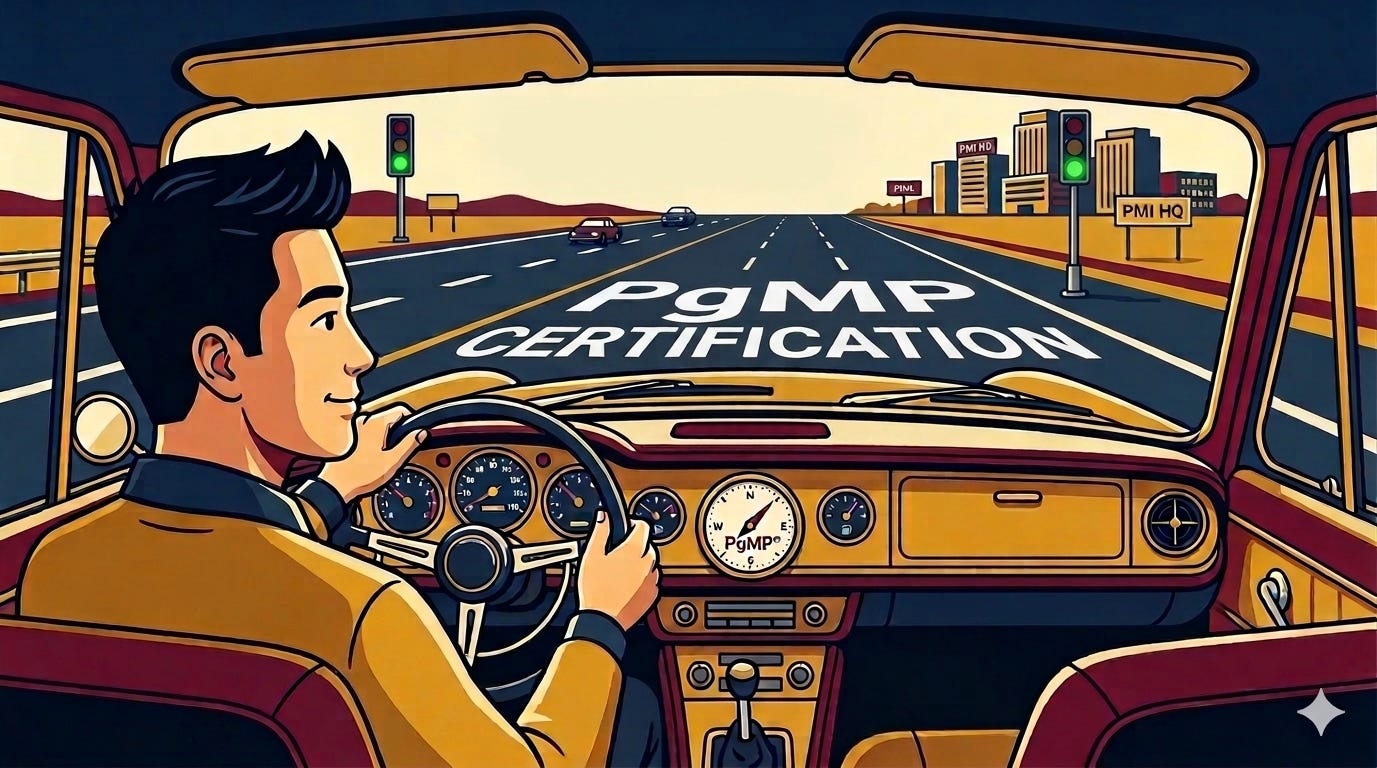
About the “Project PgMP Certification” Series
In this series, I share my journey toward PgMP certification, including my experiences with the application, educational materials, and exam. If you are considering the PgMP certification or are curious about a mid-career education adventure, this series is for you. This post, Part 2, details the organization and certification itself. Also, while I strive to include accurate details about the PgMP certification, please refer to PMI’s website as the final authority on all requirements and processes.
1. What is the Project Management Institute (PMI)?
PMI is a non-profit organization and billed as “the world’s leading professional organization for project, program, and portfolio management” (4). Checking its numbers, that’s pretty accurate. With 782,408 global members (2), it far surpasses the European-based competitors, the International Project Management Association with >250,000 certified practitioners (5) and the Association for Project Management with over 40,000 members (6). PMI is no “spring chicken” either; it was founded in 1969 and, in 2024, generated over $345 million in total revenue and held over $750 million in total assets (7).
The organization hosts a deep bench of educational offerings that span a progression of the pro-port management** disciplines… from project to program to portfolio management. PMI also offers specialization certificates, its most popular being the Agile Certified Practitioner (PMI-ACP) and the Risk Management Professional (PMI-RMP) (1).
The only notable absence is a product management certification, which I suspect reflects a decision about PMI’s preferred educational scope for the field. That being said, you’ll still find product management incorporated in the educational material and recognized as an interdependent discipline (8, p. 21-24).
While PMI does many more things... peruse the website... the other important item that stood out was their community-building offerings, particularly hosting local chapters to foster in-person connections. I’m part of the Mass Bay Chapter, which is highly active in New England, with a large annual conference complemented by multiple online and in-person events hosted each month.
As professional associations go, the important quality here is that the PMI is big: people, geography, resources, and offerings…big, big, big, big! While scale doesn’t guarantee content quality, it provides brand recognition and a global presence that supports their claim as the global standard. For my career, these are valuable attributes.
**Pro-Port Management: the application of knowledge, skills, and principles to manage a project, product, program, or portfolio.
2. Details on the PgMP certification
So what is this much lesser-known sibling to the PMP?
If you are thinking: Is the PgMP about running a really big project? Good guess, but no.
Aren’t projects and programs the same? Also no.
If you feel hazy about the differences between project, program, product, and portfolio management, you are not alone. Throughout my professional career at non-profit organizations, the terms “programs” and “projects” were used interchangeably. “Product management” was occasionally brought into the mix. The term “portfolio management” simply did not exist. At non-profits, these words are still a jungle juice of job titles, responsibilities, and career tracks; you don’t know exactly what you’ll get (sidenote: providing clarity to the program management career track is one goal of this Substack).
So don’t feel left out in the cold if you don’t know the exact difference between a PMP and a PgMP based on the names alone. In fact, the realization that PMI treated project and program management as distinct, separate disciplines was yet another reassuring reason why I pursued this particular certification.
Exercise: Assess PMI’s influence in your professional community
How prominent are the PMP and PgMP certifications in your network? Try searching “PMP” and “PgMP” among your contacts on LinkedIn. Try different filters, such as limiting the search to your local region. You’ll start to see if the PMP or PgMP is a common or rarer part of your professional universe.
For myself, I don’t have first-level connections with a PgMP and only have a handful of second-level connections in the Greater Boston area with the certification. The PMP is much more common.
3. PMP vs. PgMP
According to PMI, the PMP “demonstrates your ability to lead projects in any industry” (9). In contrast, the PgMP “demonstrates an advanced level of expertise through managing multiple projects in a coordinated way” (10). Going deeper into the disciplines, there are two core differences to consider between a PMP and PgMP:
Outcomes: Projects aim to create deliverables, and programs generate benefits. In less jargony terms, if you run a project, you are creating a defined thing (i.e., a building, a service, a boat!). If you run a program, the details of what you create are secondary to the creation’s impact. For non-profits, this aligns with societal benefits such as reducing hunger, improving literacy, and preventing disease.
Structure: While projects can be highly complex, every activity is conducted in the service of making the product or service. Therefore, the setup of projects are often more straightforward than programs. Conversely, programs are collections of projects, often carried out over time, and new projects will often be defined along the way. In a program, you’re in charge of those developments as well as weaving everything together to achieve the larger benefit.
With different aims and structures, project and program management are distinct skill sets and professions. Both require significant learning, and one profession is not necessarily more advanced than the other. A PMP can lead a multi-billion-dollar project, while a PgMP manages an itty-bitty program. While there is an organic progression from PMP to PgMP, that skill set advancement is less pronounced than, say, the bachelor’s to master’s to doctorate collegiate track.
Nor is one required before the other (i.e., earning a PMP certification is not necessary to obtain the PgMP certification). If you have experience managing both projects and programs, choosing a certification is more about personal work preference than about following a defined educational order.
For myself, I worked on programs for many years and was always drawn to weaving together multiple projects over time and through ambiguity to ambitious ideals (e.g., integrating care and advancing women’s equity). While it’s the far less well-known certificate, the PgMP made the most sense for my career goals.
Fun Fact: I called this series “Project PgMP Certification” with intention. To get a PgMP or any PMI certificate, you are performing a set of defined activities to reach a distinct deliverable…the PgMP certification. Therefore, gaining a certificate is a project, not a program.
4. What does it take?
The PgMP certification was first offered in 2007 and can be earned through a combination of job experience and demonstrated competency, as evidenced by an extensive application and an exam. At a high level, the entire process includes:
Meeting the underlying requirements of education, combined with years of experience managing projects and programs.
Completing and gaining approval for your application
Learning everything in “The Standard for Program Management”
Passing a long, standardized exam
A general rule of thumb for the PMP certification is that you’re looking at 150+ hours of study time. I’ll share more specifics about my timeline for completing the PgMP later, but it’s comparable. These certificates are a commitment, and even for the highly experienced professional, it’s not a quick or easy undertaking.
The big win around the PgMP (or any PMI certificate) is the cost when compared to other mid-career educational opportunities. I’ll share where I ended up with expenses (fees, educational materials, etc.) in a future article, but PMI prices the certification at $800 for PMI members and $1000 for non-members (note: joining PMI annually costs $164, so it’s cheaper to join the organization versus pay the non-member price) (10, 11). In comparison to other educational opportunities, from graduate degrees to college-run certification programs (easily over $10,000+), a certificate in the low thousands is an amazingly cheap option for the possibility of adding more letters from a well-known institution after your name.
5. Risk assessment
In considering my big-picture goal of finding a better way to manage programs at non-profits, the PgMP certification was certainly appealing. It was from a widely recognized organization, had a nearly 20-year history of implementation, and, from the outside, looked achievable at a relatively low cost compared to pursuing other degrees. Good, good, good!
In my review, the major potential risks were 1) the quality and applicability of the content were a proverbial crapshoot, and 2) the prospect of NOT passing the exam.
Content
As stated before, this pathway to a PgMP certification was not well-trodden in my industry. No immediate mentor or peer could speak to its value or applicability to our work. As we are a society that runs on referrals, I had none, and that was moderately disconcerting.
Further, my previous professional training experiences in project management – most significantly with Six Sigma – have always been insightful but never directly applicable to the unique characteristics of the non-profit industry. With manufacturing and, now, the tech sector dominating the American economy, most professional trainings in the pro-port management space are designed for these industries. While those trainings provided useful tips and tricks, it always takes a lot of translation to figure out what applies to my quirky, non-profit, small-program world. Regarding my big question, “How do you run a non-profit program successfully?”, there was no litmus test for whether the content would be any good, or, if good, whether it would apply to the non-profit sector.
Exam
I did have one friend who was pursuing their PMP certificate. She gave me a heads up that the test was hard, like “you’ll most likely fail on the first try” hard. Further, throughout my life, I’ve never excelled at standardized tests. I’m not quick at answering multiple-choice questions and have always had to study far more than my peers to get comparable scores. Having not taken any test in over a decade, there was a real possibility of making it all the way through this process and failing the exam – perhaps repeatedly.
6. Giving “Project PgMP Certificate” the green light
Despite those risks, it made sense to get started. To give PMI credit, this is clearly not their first rodeo, and they have the certification process set up so that you can begin without spending any money up front. It’s only when your application is accepted that you pay the application fee. With my assessment coming up mostly roses, I ultimately decided to keep exploring the PMI PgMP certificate and started the application.
That much longer-than-expected application is next up for the “Project PgMP Certification” series. Look for my next posting in two weeks.
This article’s song pairing is “Green Light” by John Legend. I’m definitely ready to go right now.
References
PMI Community Numbers Q1 2026 [Internet]. ProjectManagement.com. 2026 [cited 2026 May 14]. Available from: https://www.projectmanagement.com/articles/1187546/pmi-community-numbers-q1-2026
McGaughy C. Final PMI Fact File - December 2023 [Internet]. Projectmanagement.com. 2024. Available from: https://www.projectmanagement.com/blog-post/76129/final-pmi-fact-file---december-2023
If you want something you have never had (Spurious Quotation) [Internet]. Monticello. 2026. Available from: https://www.monticello.org/encyclopedia/if-you-want-something-you-have-never-had-spurious-quotation
About [Internet]. LinkedIn. [cited 2026 May 14]. Available from: https://www.linkedin.com/company/projectmanagementinstitute/about/
Bello I. What Is IPMA Certification Ireland? Complete Guide 2026 [Internet]. Institute of Project Management (IPM) Ireland. 2026 [cited 2026 May 14]. Available from: https://projectmanagement.ie/blog/what-is-ipma-certification-ireland-complete-guide-2026/
APM. APM - the chartered body for the project profession [Internet]. Apm.org.uk. 2025. Available from: https://www.apm.org.uk/
Flipsnack. PMI 2024 Annual Report [Internet]. Flipsnack. 2024. Available from: https://www.flipsnack.com/79D666ED75E/pmi-2024-annual-report/full-view.html
Project Management Institute. A guide to the project management body of knowledge: (PMBOK guide). 8th ed. Newtown Square, Pa: Project Management Institute; 2025.
Project Management Institute. PMP Certification [Internet]. www.pmi.org. 2024. Available from: https://www.pmi.org/certifications/project-management-pmp
Program Management Certification | PgMP [Internet]. www.pmi.org. Available from: https://www.pmi.org/certifications/program-management-pgmp
PMI Membership [Internet]. Pmi.org. 2026. Available from: https://www.pmi.org/shop/us/p-/membership/pmi-membership/memb-b-01?s_kwcid=AL
Disclosure: In writing this series, I am not employed or compensated by PMI in any way. My affiliation with the PMI is solely as a member and PgMP certificate holder. The experiences and opinions included here are my own.