


A discipline needs a name.
One of my continual hang-ups as a program management professional is the lack of a clear term to describe the greater discipline. That is everything encompassing the management of projects, products, programs, and portfolios.
In other career fields, lawyers have the “law,” doctors have “medicine,” and artists have “art.” A professional who works across projects, products, programs, and portfolios has ________ (play audio to actually hear the crickets chirping).
Organization? Change? Transformations? More projects?
This weakness in our workforce’s vernacular is detrimental. Fundamentally, it limits our ability to communicate concepts that span all disciplines, and, in more subtle ways, it hampers our workforce’s general knowledge of their entire field. In recognition of the need for a word, I’m introducing the term “pro-port management.”
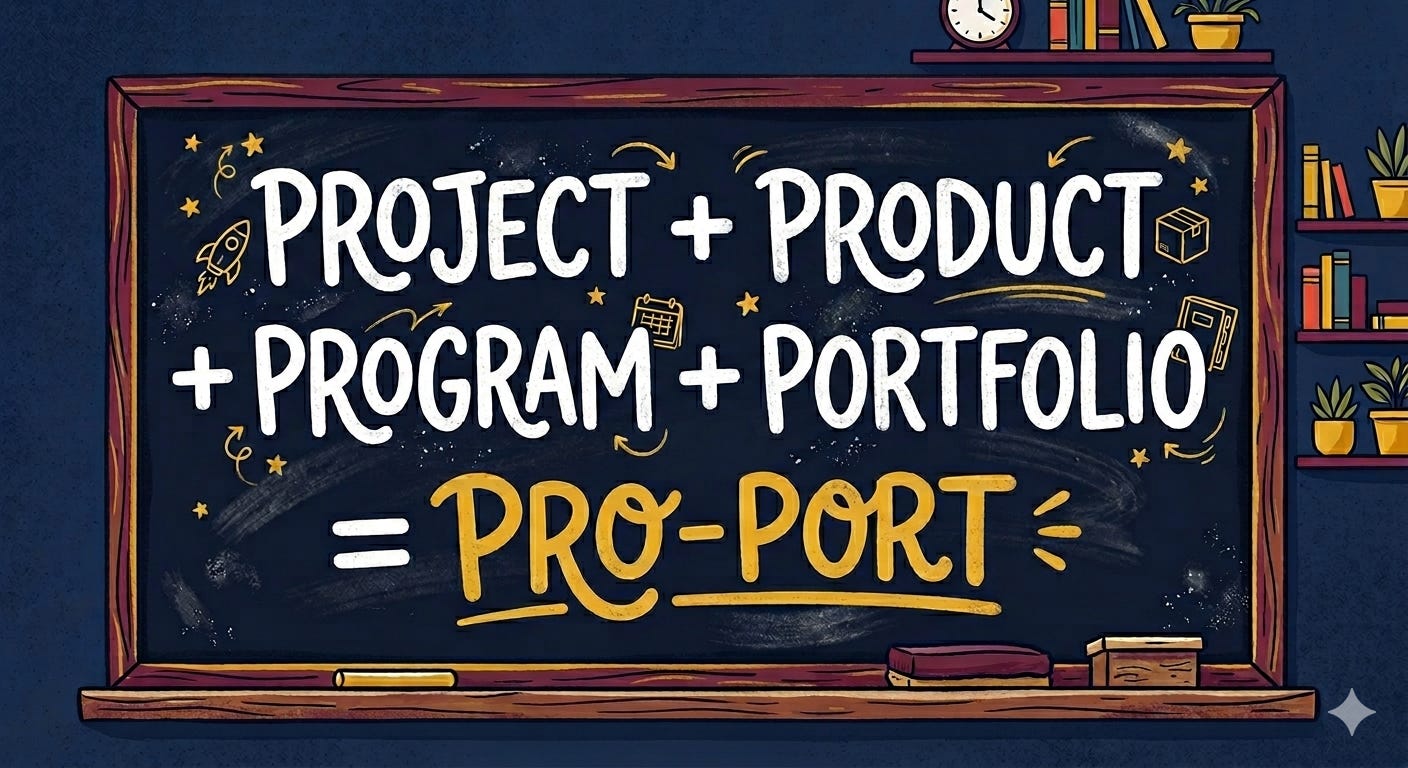
Pro-Port: a compound term that refers to projects, products, programs, and portfolios.
Pro-Port Management: the application of knowledge, skills, and principles to manage a project, product, program, or portfolio.
I. Current Standards
“But there has to be an umbrella term. Isn’t there?” The existence of an overarching term to describe the entire discipline feels like it should already exist, but I didn’t actually know of one.
To assess current usage for how our broader discipline is referred to, I consulted the resources where I most expected to find a predominant answer: the major professional associations that represent our field and several artificial intelligence (AI) platforms, specifically Gemini, ChatGPT, and Claude.
What are professional associations doing?
For this assessment, I focused on two major professional associations: the Project Management Institute (PMI) and the International Project Management Association, specifically IPMA-USA’s website. Both appear to use the terms “project” and “project management” to refer to the parent discipline (projects through portfolios) as well as the specific “project management” sub-discipline.
Common themes across the two organizations are:
The professional associations have “project management” in their title.
Mission statements and visions reflect their dedication to the field of project management.
The offerings (certifications and educational material) extend beyond project management to include the program and portfolio management sub-disciplines.
Sidenote: Products are mentioned across materials, but product management is not included as a specific sub-discipline in the offerings. More on this later.
My interpretation of this setup - where the mission says “project management,” but the certifications specify the inclusion of program and portfolio management - is that “project management” represents the greater whole.
For a specific text example where the word “project” is explicitly defined to represent all the disciplines, PMI states in the methodology section of their report “Global Project Management Talent Gap” that “Researchers began by identifying 172 job titles related to project professionals (including project, program and portfolio managers, Agile professionals, product managers and product owners)” (1, p.12).
Professional associations are using “project” in a polysemous way. Like many words in our English language (here’s looking at you…orange), one has to interpret via context clues when the content refers to the parent or the child discipline.
What AI has to say about it?
Then I asked three AI platforms (Gemini, ChatGPT, and Claude) the following:
“What is the umbrella term for the discipline that includes project, product, program, and portfolio management?”


Here’s a consolidated list of the responses from across the three platforms:
Organizational Project Management (OPM)
P3M
Strategic Execution
Delivery Management
Strategic Management
Enterprise Project Management (EPM)
Project and Portfolio Management (PPM)
Organizational Management
Strategic Portfolio Management (SPM)
Governance and Management of Projects
The good news is there are options here. The favorite choice across the platforms appears to be “Organizational Project Management (OPM),” created by PMI and aligned with PMI’s polysmic approach for project management (although I don’t see them use the first word “organizational” very often). The AI platforms also shared a handful of general business terms, such as strategy and organization. Finally, there’s the moderately promising acronym of P3M, the three “Ps” intended to symbolize project, program, and portfolio, and the “M” for management.
II. Defining Requirements for a New Name
Assessing this list of terms…spoiler alert….I concluded that there’s no perfect term commonly used today. All have relatively stark failings as a term to represent our entire discipline of project, product, program, and portfolio management. But the weaknesses of the current terms reveal the requirements criteria for a better one.
Let’s look at the terms in three buckets: a) the dual usage of project, b) generalized business terms, and c) P3M.
“Project Management”
I do not speak for the professional organizations, but I can theorize why they likely use project management as both a parent and child term to describe the disciplines. The word “project management” speaks to the overwhelming majority of their core customers – project managers. At PMI, there are currently 1.66 million (2) certified project management professionals (PMPs) out there compared to an estimated ~6,200 program management professionals (PgMPs) and ~2,000 portfolio management professionals (PfMPs) (3). Focusing the language on the sub-discipline that accounts for 93% of their certificate holders (((PMP + CAPM)/Active Certifications) * 100) makes a lot of sense from a branding and marketing standpoint. I imagine the other professional associations have similar customer splits and subsequent market drivers to highlight project management.
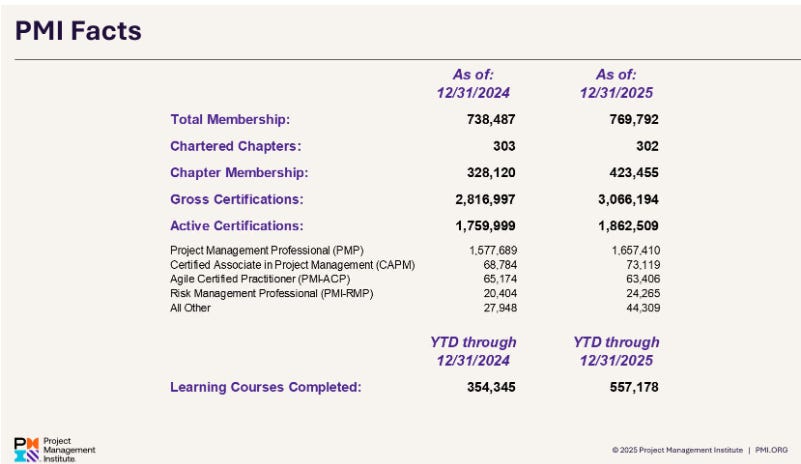
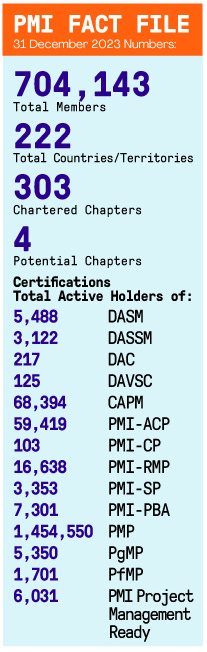
The drawback is that this polysemic usage then runs counter to their own educational standards, which delve into the specific, very real differences between projects, programs, and portfolios. As a learner, it’s confusing. As a potential buyer, it also hides programs and portfolios as part of its offering. When I speak to other professionals in the space, it often comes as a surprise that PMI offers program and portfolio management certifications. While most know the connection between projects and programs, few connect portfolio management as a closely related discipline, either. This leads us to our first requirement.
Requirement #1: We need a term that is unique and has minimal overlap with any currently used terms.
General Business Management Terms
I would argue that more ubiquitous business terms, such as “Strategic Execution” or “Delivery Management,” are also poor fits.
My first issue is that the scope of these terms doesn’t necessarily align with the field of project, product, program, and portfolio management. For example, Strategic Management is a gigantic ballpark that covers how leadership sets and then manages the direction for the entire organization. Yes, project, product, program, and portfolio management are essential parts of that ultimate success, but only part of it.
Requirement #2: We need a term that exactly matches the scope of the four disciplines.
My second issue is auditory. All four of the key terms have that distinct “Pah” sound. “Project”, “Product”, “Program”, and even the black sheep “Portfolio” keeps the “P” pattern. Using terms like “strategy” or “organization” to define the parent discipline for all these “P” words sounds wrong. It's like naming your dogs, Alpha, Beta, Gamma, and…Dug. When you violate a pattern, the outlier stands out.
Requirement #3: We need a word that has that distinct “P” sound to match the rest of the disciplines.
“P3M”
Now here we have a potential contender. The final and most promising term is “P3M” with the P3 standing for the three terms “project”, “programme”, and “portfolio”. The “M” stands for management. This term comes from the United Kingdom (hence the change in spelling of programme) in the early 2000s; it is the closest to an all-encompassing umbrella term.
This term is admittedly pretty good in comparison to the options above. The phrase is unique and more closely aligns with the scope of the broader discipline than “project” or the more general business terms. Finally, it includes the letter “P”.
That being said, I’m still left a little wanting on two fronts. The first issue I have with the term “P3M” is that it’s an acronym and one you need to know. You can’t infer what P3M stands for if handed the term in isolation.
Think if you are talking to your grandmother at the next holiday and say, “I’m looking into a career in P3M.” You will have more explaining to do. Also, P3M reminds me of coding languages (python, SQL, Javascript). If I were that nana, I’d think my granddaughter was becoming a software developer.
Requirement #4: We need a word that one can intuit its meaning without direct explanation.
My second issue is that there’s no room for product management inclusion within the discipline. P3M means there are three “P” terms - not four. I personally want to be inclusive of product management.
Admittedly, this is an area where I personally deviate the most from common practice. The professional associations PMI and IPMA certainly mention products in their materials, but do not offer certifications in product management. But in my lived experience, I’ve often managed “products” within my programs, such as a survey that measured the patient experience of integrated care (PICS) at Boston Children’s Hospital or the format of our educational “Salons” at the Boston Chapter of the Alumnae-i Network for Harvard Women (ANHW). I want the door to be open to product management as part of our broader discipline.
Requirement #5: We need a word that allows product management to be included.
To put this all together, by examining major professional associations and using AI platforms, I’ve found numerous terms currently used to describe the parent discipline that encompasses project, product, program, and portfolio management. Yet, in that review, I found many major drawbacks with each term that helped define the requirements criteria for a better word or phrase.
With the stage now set, I’m throwing my hat into the ring to call the parent discipline “Pro-Port Management.”
III. The Case for “Pro-Port Management”
Pro-Port is a combination of the first three letters “pro” found in project, product, and program. Then the first four letters “port” of portfolio. It is said succinctly together, “pro-port.” I include a hyphen to emphasize that the word is a combo of the starting syllables of the core sub-disciplines. I also capitalize both words when used as a title or the start of a sentence, “Pro-Port.”
Now, let’s assess “Pro-Port” against the five defined criteria.
Requirement #1: We need a term that is unique and has minimal overlap with any currently used terms.
Pro-Port appears to have room to enter our language without causing market confusion. Admittedly, the word “proport” is a word in the English language, but it’s a historic, alternative spelling of the infrequently used term “purport.” Purport is not a word I frequently hear in conversation, as supported by findings from Google Ngram Viewer. This is a fascinating tool that graphs word frequencies in digitized texts. Purport comes in at 0.00007% frequency of use against all words written in 2022 and has been declining in usage for much of the past two centuries. For comparison, I mapped our disciplines’ more commonly used terms “project”, “product”, “program”, and “portfolio” as well as the alternative spelling “programme”, which are used far more frequently (0.0009 – 0.009%).
Finally, the historical word “proport” is used at 0.0000002% frequency and “pro-port) at 0.000000005% frequency. Essentially, these words are non-existent in the current texts.


I like pro-port management because it does not overlap with a currently used business term and is not likely to be confused with its closest word twin, “purport.”
Requirement #2: We need a term that matches the scope of the four disciplines.
By making the word the starting syllables of the four sub-disciplines, it inherently has the same scope: projects, products, programs, and portfolios. This structure eliminates any confusion about whether we are incorporating broader business management topics, as suggested by terms such as “organization” or “strategy.”
Requirement #3: We need a word that has that distinct “P” sound to match the rest of the disciplines.
My favorite part about this word “Pro-Port” is in the auditory. Specifically, if you are using this word in conversation or presentation, it matches the sounds and cadence of the other disciplines, yet it is not so close as to be indistinguishable from the others.
For example, try saying the following sentence:
“My university started a project to build a pro-port management program as a product in its educational portfolio.”
As the second halves of the words are “ject”, “duct”, “gram”, and “folio”, using the word “port” in the second half of the term makes it stand out as distinct from the pack. The only verbal hang-up I’ll admit to is that saying “pro-port portfolio” can make you stumble when saying “port” twice, but I think it’s livable.
Requirement #4: We need a word whose meaning one can intuit without direct explanation.
A goal of that similar structure and use of “Pro” and “Port” in the word is to match the existing phrases very closely. By matching those existing words, I hope that a layperson could figure out that you’re talking about the overarching discipline. This is an assumption and will need further testing.
Requirement #5: We need a word that allows product management to be included.
Finally, the opening word “pro,” of course, matches the words project, program, and product without placing a numerical restriction on which terms are indicated. By leaving “pro” to represent all terms, there’s an opportunity for users to include or exclude “product” without creating a logic gap in the language.
“Pocketful of Sunshine”
That’s my case for “pro-port management.” What do you think? Love it? Hate it?
I plan to use “pro-port” in this newsletter and see how it feels. At minimum, it’s a small but helpful tool for my writing. Helping to untangle the distinction between my favorite subject, “program management,” and its parent discipline.
I hope you’ll also find it valuable, particularly towards thinking of our work around project, product, program, and portfolio management as a holistic discipline and a progressive career. Maybe someday it will be easy to say, “I’m a pro-port management professional.”
For this article’s song pairing, I’m choosing “Pocketful of Sunshine” by Natasha Bedingfield. I want to say this choice is about optimism about a brighter future, but honestly, I live in New England, which has been covered with four feet of snow this winter. I actually need a real pocketful of sunshine, as the skies keep dumping sleet every day.
References
Up to 30 Million Project Professionals Needed by 2035 [Internet]. Pmi.org. 2023. Available from: https://www.pmi.org/learning/thought-leadership/global-project-management-talent-gap
PMI Community Numbers Q4 2025 [Internet]. ProjectManagement.com. 2026 [cited 2026 Mar 5]. Available from: https://www.projectmanagement.com/articles/1064504/pmi-community-numbers-q4-2025
McGaughy C. Final PMI Fact File - December 2023 [Internet]. Projectmanagement.com. 2024. Available from: https://www.projectmanagement.com/blog-post/76129/final-pmi-fact-file---december-2023
I find that with the invention of agile project management, a lot of confusion began. In the old days, product management was a distinct profession focused on planning business needs — specifically, how a product should evolve. Back then, "product" implied something tangible, something that is physically produced. Once that was defined, another profession took over: the project manager, who was responsible for realizing the desired change.
With the growing importance of software, what was formerly called a "service" — an immaterial customer offering — suddenly became a "product," and product managers started caring about implementation details. This blurring of boundaries, combined with mixing agile and classical project management, creates enormous confusion, because the same terminology is now used for completely different things.
This is precisely why I appreciate your attempt to coin something new. A clearly defined hybrid approach may well be the clarity our fast-moving, profit-oriented world needs as well.