


“It is easy to be wise after the event.”
― Arthur Conan Doyle, The Complete Sherlock Holmes (1)
In the last article, I covered the trials and tribulations of my journey to complete the Program Management Professional (PgMP) application last year, amassing 25.5 hours of work with numerous stumbles along the way. That was a year ago, when I was essentially in the dark about everything related to the Project Management Institute (PMI). Now older, wiser, and with a PgMP certification under my belt, I can see ways to approach the application with more of a scalpel than a sledgehammer.
Using my detective skills to do a post-mortem, here are my top recommendations for approaching the PgMP application. These are all aimed at finding the right balance between crafting high-quality materials, preparing for the exam, and staying efficient.
Top Recommendations
Log your projects and programs early and often
Study “The Standard for Program Management” (SPM) (2) before you attempt the “Experience Summaries”
Use AI, but with guardrails
Quick Note: I’m going on vacation and will miss one publishing cycle. My next article is scheduled for July 23rd. Enjoy this early summer sunshine!
About the “Project PgMP Certification” Series
In this series, I share my journey toward PgMP certification, including my experiences with the application, educational materials, and exam. If you are considering the PgMP certification or curious about a mid-career educational adventure, this series is for you. This post, Part 5, is my debrief on the PgMP application and what I wish I had done differently. If you are not yet familiar with the PgMP Application, check out “Part 4: The Long and Winding PgMP Application” or PMI’s PgMP Certification webpage for more details.
While I strive to include accurate details about the PgMP certification, the PMI is the final authority on all requirements and processes. To that end, if you are starting the PgMP process, make sure you read the “PgMP Handbook” (3) and refer back to it for guidance.
I’ve included a link to the 2024 version, which is what’s posted on the PMI website today (6/25/2026). Remember to check the PMI website for updates.
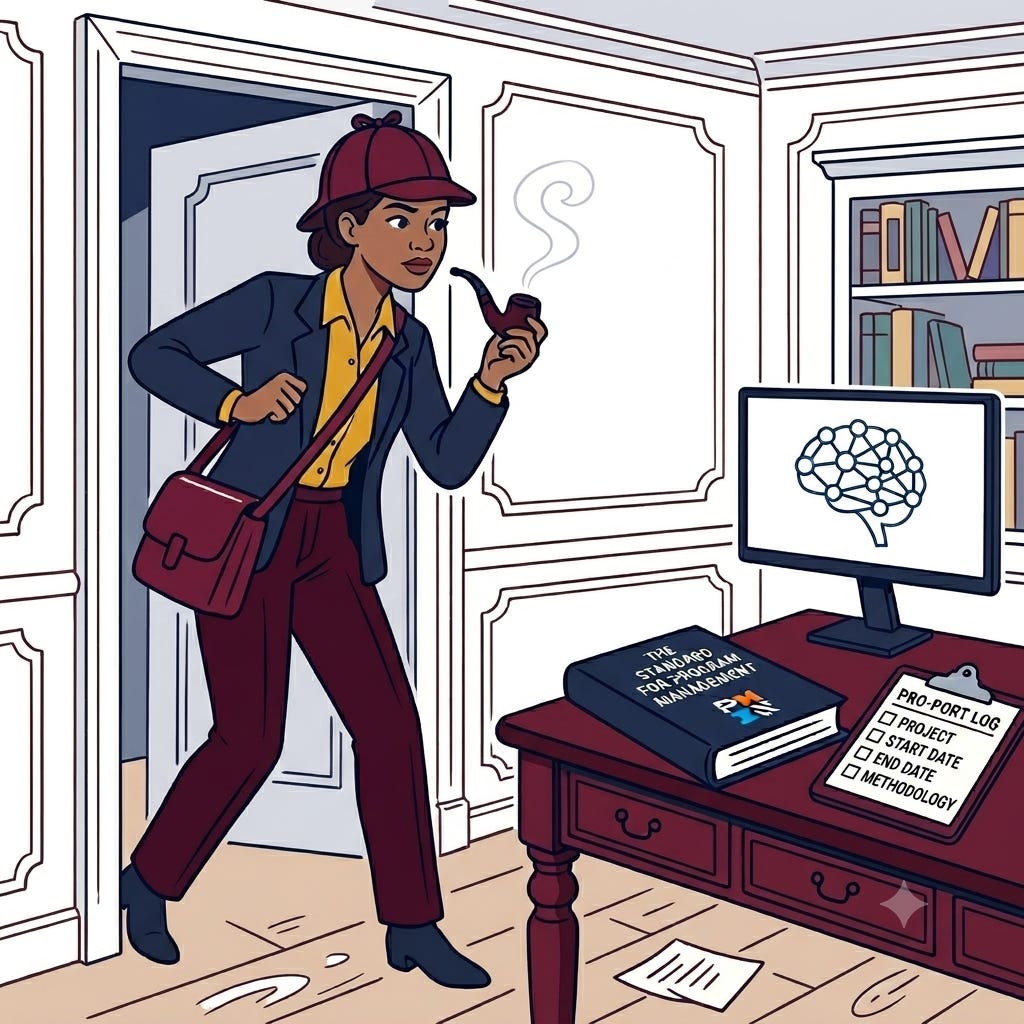
Keep a “Pro-Port Log” and keep it at home
Admittedly, this piece of advice is very unfair, because it requires a time machine. In the off chance I’m catching you early enough in your PgMP journey, make sure to regularly log the high-level details of your projects, programs, and programs’ projects when they happen. For the PgMP application, I spent over 10 hours digging up old emails, resumes, performance reviews, and press releases to find dates and facts about work long gone at companies past. During that hunt, I certainly wished I had kept a running log of all my pro-port management work. My old resumes, which reduced years down to a few bullet points, were entirely insufficient.
*Pro-Port: a compound term that refers to projects, products, programs, and portfolios.
Pro-Port Management: the application of knowledge, skills, and principles to manage a project, product, program, or portfolio.
These are terms I coined, not part of PMI’s vocabulary. You can read more about these terms and my rationale for their necessity in “Introducing Pro-Port Management.”
Another important tidbit is to keep that log at home (virtually or physically). We like to keep our work and personal lives separate, which usually manifests – very legitimately – as not keeping anything related to work on your home computer or in your personal cloud. But the story of your work – what we list on resumes and speak of at job interviews - is yours. Your “Pro-Port Log” should be too. So don’t store it at work (virtually or physically). In the event of an unexpected layoff where your system access gets cut, you don’t want to lose those important details on your life.
The log doesn’t need to be extensive either. Here’s a list of data points to keep that align with the PgMP application. I’ve added a few more categories to my personal log, such as “event attendees” and “intellectual property created,” that are specific to my work:
Project/Program Title Organization
Job Title
Start Date
End Date
Methodology: Waterfall vs. Agile
Project Team Size
Project Budget
Project Description
Accomplishments/Outcome (document numbers if possible!)
Finally, now that I’m “caught up” and have a comprehensive record of my life’s work to date, I plan to keep it going. I don’t know exactly where the information will be needed next, but in our world of quantifying progress and greater accountability, having such a log on hand has to be useful for “Future-Casey.”
Learn the SPM before tackling the application
Another challenge I encountered was writing the “Experience Summaries” well before I had learned the formal material in the SPM. If you are confident in your PgMP eligibility, I’d highly recommend deviating from PMI’s recommended “Path to Certification” and saving the application to the end of your PgMP process. Instead, tackle a solid amount of learning/studying phase first, then approach the application. I suspect that you’ll save time, write better essays, and be better prepared for the exam as a result.

- Image taken from PMI’s PgMP Certification webpage on 6/24/2026
In more detail, the three experience essays in the application require you to apply your life experiences to the concepts taught in the SPM, such as governance or benefits management. As I was following the “Pathway to Certification” order and hadn’t cracked open the SPM yet, these questions caught me off guard. These weren’t the terms I used in my work, and I didn’t have a strong grasp of everything they encompassed. It meant a lot of digging and learning concepts in a scattershot way, which led to frustration and rewriting essays multiple times. Reading through my responses now, I can see that although they passed the panel review, they're too long and ungainly. I would write very different essays now that I’ve mastered the SPM concepts, and do it much more quickly.
Given that the application completeness and panel review steps went fairly quickly – far shorter in my experience than the specified 60-day timeline – you’re not likely to be held up by leaving the application to the end or near the time when you’re ready to sit for the exam. Further, the essays are an excellent study mechanism. By writing the “Experience Summaries” at the end of your PgMP learning journey, you’ll reinforce the concepts in a meaningful way rather than hammer through them.
Use AI as your application partner
While AI is promoted as the magic wand for everything nowadays, I can’t dismiss that AI’s ability to aggregate information and write prose will be extremely helpful for the essay-heavy PgMP application.
Last year, I admittedly did NOT use any AI to support my application. Honestly, this was more due to my lack of experience with AI than any ethical ethos. Now, with a year of using AI as a work partner under my belt, I can see ways it will help shorten the process – perhaps dramatically. And while it’s tempting to ask AI to write a few essays, submit something generic, and see if it works, if you want your application to pass the panel review and to set yourself up for success on the exam, I’d advise setting some guardrails. Here are four to consider:
1. Check with PMI on guidance/restrictions around AI usage
As of the date of this article’s publication, PMI does not appear to have made a formal statement regarding the use of AI in constructing your applications. Neither the currently posted “PMI Certification Handbook” nor the “PgMP Handbook” (2) contains a policy regarding AI usage or provides any indication of PMI’s preference around its usage. That said, make sure to download the latest versions of these documents and check in with PMI. As with academic institutions, there could be a day when PMI restricts AI-written material and starts running essays through an AI Detection Tool.
Sidebar: This is not to say that the PMI is ignoring the rise of AI, rather they are focused on its applicability to the practice of pro-port management. They have released “The Standard for Artificial Intelligence in Portfolio, Program, and Project Management” (4) and offer a certification around that expertise (PMI-CPMAI). I also just went to a great conference hosted by my local PMI chapter on AI and project management.
2. Share real stories
The point of the essays is to communicate your real-world experience as a way of verifying that you are, in fact, a well-seasoned program management professional. Therefore, you need to actually submit content about your real life. Maybe you write that directly, give AI prompts, or create an AI agent to pull from other source materials, but regardless of how it’s created, it needs to be authentically you. In other words, stay away from AI slop. If you turn in generic regurgitation of PMI concepts that don’t align with your reported work history, I hope the folks at PMI will detect and reject it.
3. Use AI for teaching, brainstorming, and coaching on the “Experience Summaries”
Particularly if you are writing the “Experience Summaries” before you have deeply studied the SPM, use AI to ask questions about concepts. Have a conversation about how your real-world experience fits in and see what it thinks. Share your essay with AI to get feedback and improve it. Use AI as a partner, but make sure your brain is part of the process too. You’ll otherwise miss out on the chance to further learn the concepts in preparation for the exam, where there will be no AI to help you.
4. Check out PMI Infinity™
PMI has trained an AI system on all its materials, so it’s likely your best bet for getting responses that will align with the SPM. Given the widespread proliferation of project management materials, other systems are more susceptible to sharing incompatible information. For example, I often notice that Gemini uses the terms “project” and “program” interchangeably – it’s not a hallucination, but simply mirrors what humans do in the real world. In PMI’s world, though, projects and programs are distinct vehicles of work, and if that lack of distinction shows up on your application, you’ll probably not pass the panel review.
Ultimately, you will need to make the judgment call on if and how you bring AI tools into your work to complete the application. For my PgMP application, I submitted nine ~300 to 500-word essays for a total word count of 3,429. That’s a time-consuming amount of text to compile, write, and edit. Particularly if you are running full steam at work and/or at home, you’re likely short on extra writing hours. There’s value in using AI constructively to streamline your application process so you can actually complete the application. My main caveat is to invest your time in constructing/writing those “Experience Summaries.” Don’t shortchange yourself on that learning opportunity because you’ll need every leg-up you can get for the exam (hint: it’s tough).
“Here”
The PgMP application is admittedly a bit of a monster, but I would argue a necessary one. PMI’s goal with the application is to ensure that you are actually running programs and are a program management professional. So that when you pass the PgMP exam and earn that credential, that “PgMP” means something. To that end, the application setup, with its required level of detail and essay-building, makes sense. It’s intentionally designed to be an obstacle.
But I can see ways the pro-port community could better guide prospective PgMP applicants through this process, particularly earlier in their careers. Getting advice on keeping a “Pro-Port Log” at the start of your project would certainly help. Being incentivized to learn the foundations laid out in the SPM far sooner than 3-7 years into your program management career would smooth the entire credential process. Given that PgMP credential holders are such a small population compared to the Project Management Professional (PMP) credential (~7,000 (5) vs. 1.68 million (6)), I’m a bit suspicious that these hang-ups aren’t holding back a large part of the cohort and keeping structured learning of program management from further proliferation. Given that I truly believe program management as a structured expertise is needed just as much as project management - potentially more so within the non-profit industry - we’re all losing out by not better supporting the workforce through this process.
To close, today’s song pairing is “Here” by Mumford & Sons with Chris Stapleton from their new album “Prizefighter.” You’ll hear lyrics that are all exposition, with the singers sharing their deepest vulnerabilities with another soul and hoping for acceptance. While not nearly as emotional an act, the song still reminds me of the PMI application. At submission, you're giving PMI everything about your professional experience and crossing your fingers for approval. That’s not a trivial act, and we all “… just want to belong” too.
References
Arthur Conan Doyle, Stashower D. The complete Sherlock Holmes. New York, Ny: Rock Point, An Imprint Of The Quarto Group; 2019.
Project Management Institute PMI. The Standard for Program Management - Fifth Edition. Project Management Institute; 2024.
PgMP ® Program Management Professional (PgMP) ® Handbook Contents [Internet]. [cited 2026 Jun 11]. Available from: https://www.pmi.org/-/media/pmi/documents/public/pdf/certifications/program-management-professional-handbook.pdf?rev=d0f4f6474e9d4c07b8b9bb8786303973
Project Management Institute. The Standard for Artificial Intelligence in Portfolio, Program, and Project Management. Project Management Institute; 2026.
McGaughy C. Final PMI Fact File - December 2023 [Internet]. Projectmanagement.com. 2024. Available from: https://www.projectmanagement.com/blog-post/76129/final-pmi-fact-file---december-2023
PMI Community Numbers Q1 2026 [Internet]. ProjectManagement.com. 2026 [cited 2026 May 14]. Available from: https://www.projectmanagement.com/articles/1187546/pmi-community-numbers-q1-2026
Disclosure: In writing this series, I am not employed or compensated by PMI in any way. My affiliation with PMI is solely as a member and PgMP certificate holder. The experiences and opinions included here are my own.