


In the first three articles of this series, we laid the groundwork for pursuing a Program Management Professional (PgMP) certification: knowing your why, understanding the Project Management Institute (PMI) and the PgMP as entities, and even debating the choice between formal education and self-study.
With the foundation covered on your PgMP approach, it’s time to get into the nitty-gritty. We are entering the “doing” phase, which starts by scrolling down PMI’s PgMP webpage to the “Path to Certification” section. Here you’ll find five steps outlining the order of operations for achieving certification.

- Image taken from PMI’s PgMP Certification webpage on 6/9/2026
While figuring out your eligibility is fairly quick, don’t mistake the application for a simple form to fill out. It’s deceptively in-depth, time-consuming, and a little emotional. Here, you’re required to provide extensive documentation of your work history (including essays) and start applying your critical-thinking skills to concepts presented in PMI’s “The Standard for Program Management” (SPM) (1). All this was an endeavor that became particularly challenging for this non-profit program manager, especially when I first began trying to squeeze my free-ranging career into PMI’s structure and hadn’t yet cracked open the SPM.
“I keep feeling like my experiences are so messy that the key challenge is fitting my organic experiences into the more structured terms of the PgMP application. It’s like fitting a square into a circle; it fits, but there’s a lot of gaps.”
- Entry in my PgMP time log (5/13/2025)
So let’s dive into what’s involved with eligibility and the application process. Along the way, I’ll share my own experiences - including how long the application took - and key challenges.
About the “Project PgMP Certification” Series
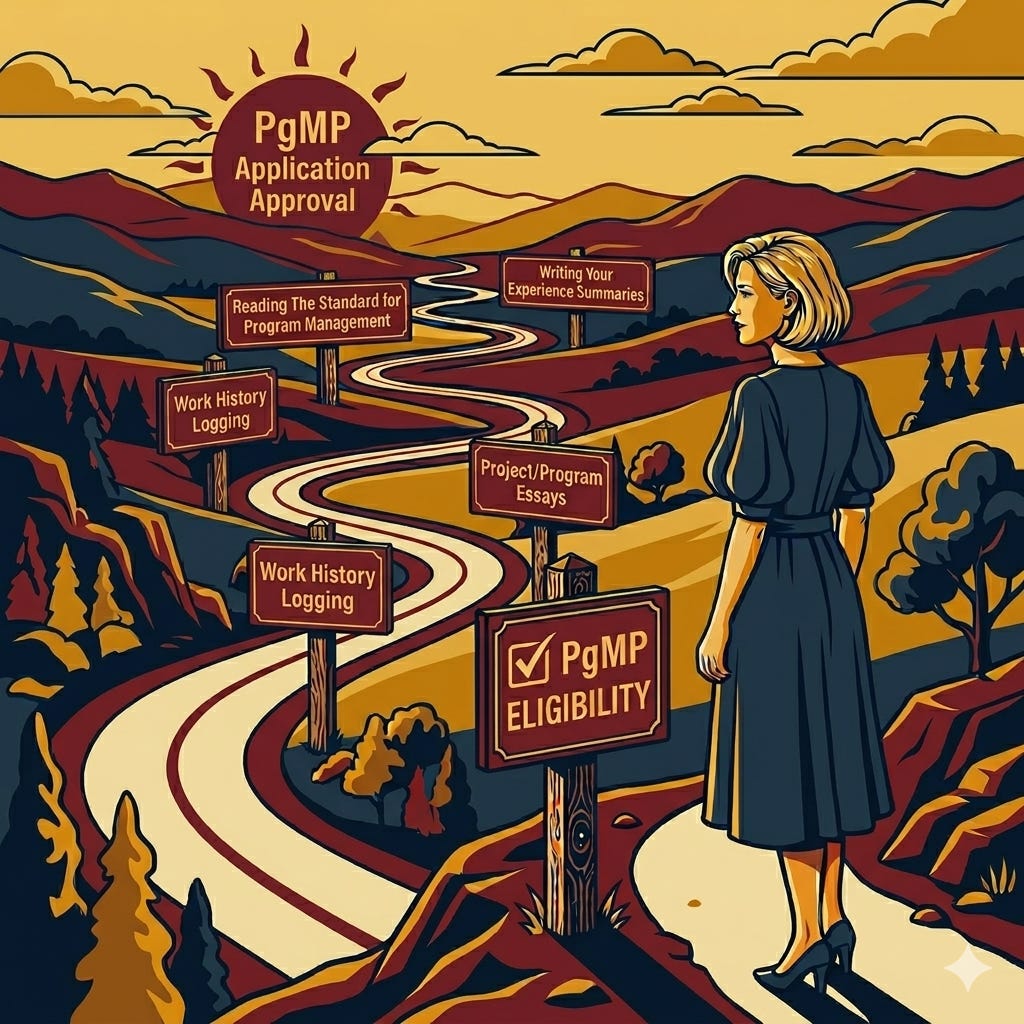
In this series, I share my journey toward PgMP certification, including my experiences with the application, educational materials, and exam. If you are considering the PgMP certification or curious about a mid-career educational adventure, this series is for you. This post, Part 4, focuses on the first two steps in the PgMP “Path to Certification”: eligibility and application.
While I strive to include accurate details about the PgMP certification, the PMI is the final authority on all requirements and processes. To that end, if you are starting the PgMP process, make sure you read the “PgMP Handbook” (2) and refer back to it for guidance. I’ve included a link to the 2024 version, which is what’s posted on the PMI website today. Please double-check the PMI website to see if they’ve released a new version as well.
Eligibility: Do you have enough work experience?
If you are even considering getting a PgMP certification, the first step is to check that you meet the eligibility criteria, which are pretty substantial (i.e., you cannot be a freshie in the workforce). Based on your education, you need the right combination of project and program management experience across six to potentially eleven years, all depending on your level of education.
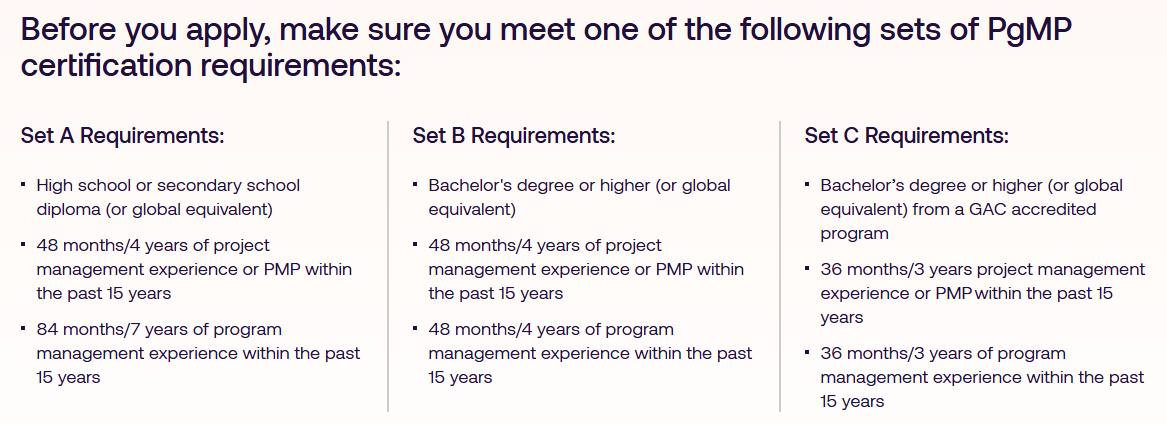
- Image taken from PMI’s PgMP Certification webpage on 6/11/2026
Personally, I met the “Track B” requirements: I have a bachelor’s degree with 48 months of experience in project management and 48 months in program management. Meeting the “project management” time requirements actually got a little tight because I jumped into program management early in my career. Through volunteer work, I fortunately had a mix of recent projects that helped build up time in the pure project management category, but I also had to reach way back to the earliest parts of my career, which abutted that fifteen-year time limit. I’ll talk about the difficulties of fitting my “free-ranging” career into PMI’s framework later in this article, but based on this setup, it appears there’s an expectation that one spends years in pure project management before moving onto programs.
For those on the collegiate track, if you went to a Global Accreditation Center (GAC) you can trim one year off the project and program management experience requirements. A GAC is essentially a formal blessing from PMI for certain degree and certification programs that focus on project management and related disciplines. I wasn’t aware of GACs and had to look it up. In Boston - where you can’t throw a rock without hitting a college campus - we have three GAC-accredited colleges: Boston University, Northeastern, and Wentworth.
One part of the eligibility requirements I do appreciate is that PMI includes “Track A” for those with a high school diploma, which requires seven years of program management experience. I am a firm believer that pro-port management* is for everyone. The ability to lead teams in creating and implementing new ideas is a core human skill and experience, regardless of educational attainment. I really like that PMI doesn’t imply that a college education is required to work in this field and be recognized as a top performer. Track A ensures this certification is open to nearly everyone. That’s great! Good job, PMI!
My only quandary in this eligibility criteria is there’s a polarity in requiring years of work experience before incentivizing educational attainment. It was notably hard to set my ego aside and buckle down to learning a profession I felt I already knew pretty well. I wish there were something in the PMI offerings that encouraged people to learn “The Standard for Program Management” much earlier in their careers. There’s admittedly a “cart before the horse” aspect to the setup here.
*Pro-Port Management: the application of knowledge, skills, and principles to manage a project, product, program, or portfolio.
This is a term I coined, not part of PMI’s vocabulary. You can read more about this term in my article “Introducing Pro-Port Management.”
The application or how I spent 25.5 hours of my life
The next step on the PgMP track is to “Complete the Application.”
In terms of approach, I recommend thinking of the PgMP application less as a registration form and more as a college application or job interview. It requires extensive information gathering, critical thinking, and communication skills to be ready for submission.
At a high level, you need to prepare:
Information about projects you’ve managed, including a short essay on each that includes “project objective, outcome, your role on the project, and your responsibilities and deliverables.”
Information on the programs you’ve managed as well as a listing of all the program’s projects - this part took a long time - and then a similarly framed essay as above on each program.
Three “Experience Summaries,” where critical thinking comes into play. For these questions, you need to demonstrate your lived work experiences against concepts from “The Standard for Program Management.” See the following example:
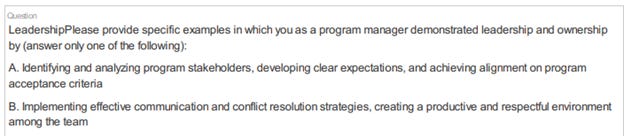
- Image taken from a copy of my PgMP application dated 6/12/2025
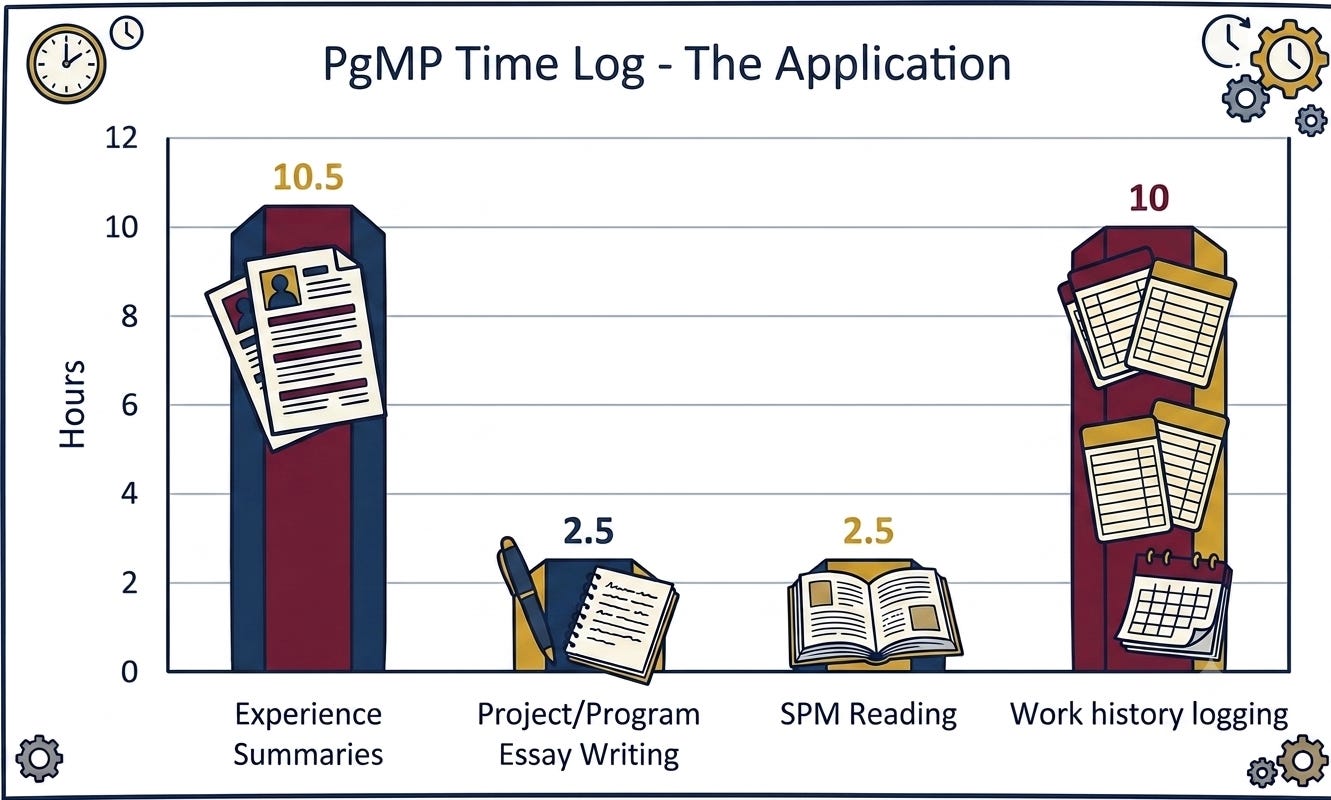
For myself, I ended up submitting ~36 line items about the different programs and projects I’ve managed over the past fifteen years, as well as nine ~400–500-word essays (a total word count of 3,429). In total, it took me 25.5 hours to complete the application over 79 days. I tackled everything in small 1- 2-hour blocks and came back to preparing the application 21 separate times. Here’s a task breakdown of my activities based on my time log.
This application’s top challenges
Long story short, this is a tough application. At surface level, it required extensive data gathering, and the “experience summary” essays asked for answers aligned with a framework I had yet to learn. But dig deeper, and I can see that many of the challenges stemmed from the heady process of reflecting and summarizing a vast amount of my life. The whole process edged much closer to writing an autobiography than to creating a resume or LinkedIn profile. Reading old materials and writing about the work pricked at the emotions and memories long stored in the deep freezer of my brain. Further, there was something disconcerting about exposing one’s life’s work to a bunch of strangers at PMI to judge. Would it be deemed sufficient?
There’s a vulnerability that made this application far more mentally taxing than I expected. Let me tell you more through this list of my top challenges.
1. Digging up the past
As mentioned, you need to aggregate details on the numerous projects and programs you’ve managed, totaling between six to eleven years of experience, plus essay writing. That’s a lot of history to account for, and unless you have masterfully logged every project/program across your life, it’s genuinely difficult to figure out activities that happened over a decade ago at a company you’ve long since left. For myself, I oversaw two programs that consisted of many little projects, which meant a lot of recall and investigation. To get to an accurate list, particularly on timeframes and outcomes for my former program, I sifted through scraps of publicly available information online and spent many quiet lunch breaks jogging my memory on work I hadn’t thought about in a long time.
2. Fitting my unstructured non-profit career into PMI’s framework
As I’ve written about in past articles, my career experiences in non-profit project and program management were pretty free-ranging. There were no common standards, methodologies, career ladders, or skill sets.* Further, PMI and its standards were far from in the picture, with few, if any, colleagues holding their certifications. Therefore, it almost felt like a translation process to take my “free-range” programs and fit them into the structure set by PMI.
*A key aim of “The Non-Profit Program” is to address this lack of common standards, methodologies, career ladders, and skill sets in the non-profit industry.
3. Navigating uncertainty in my work history
“I’m worried that they’ll see my work as event planning and not program management. :( ”
- Entry in my PgMP time log (5/2/2025)
While for some of my work, I was a program manager who ran “The Integrated Care Program”, for almost everything else, my job title and related work were not formally called projects or programs. This vernacular raised sizable uncertainty about whether my work would count from PMI’s perspective. I spent additional time considering the context needed to convey that the body of work was conceptually a project or program, despite the lack of a conventional name. For example, in my current work, I’m President of the Boston Chapter of the Alumnae-I Network for Harvard Women. I oversee a Steering Committee that organizes numerous events and activities (i.e., projects), all aimed at advancing women’s equity and leadership in Greater Boston. It’s definitely a program in concept, but it certainly doesn’t sound like one. While, thankfully, all my work was readily accepted by the PMI, I remain in the dark about whether such submissions were right on the line of acceptability or easily approved.
4. Representing failures
With the inclusion of essays that require you to report on outcomes of the work, you’re inevitably going to run into projects or programs that didn’t go well. Nowhere in the PgMP Certification Handbook (2) does it indicate that the quality of your work is evaluated, yet failures are sensitive beasts to communicate in the professional world. Do you admit to a failure bluntly, use omission/redirection to downplay the details, or take the time to provide further context (such as external circumstances that led to the failure)? I opted for the third, which meant a lot of writing and editing. In my case, there was also an emotional factor to contend with, as it was the first time I wrote directly about the failure of a once-beloved program at Boston Children’s Hospital – something I now do openly on this Substack – but finding the words to convey honesty while maintaining professionalism was a process unto itself.
5. Having to apply PMI concepts too early in the learning process
My major criticism of the application is its “experience summaries,” which require you to apply the constructs and verbiage taught in the SPM to your work. I was thirteen hours into preparing the application by the time I got to these questions, and it mentally felt like hitting yet another brick wall. These were complex questions that used terms reflecting a worldview of program management I hadn’t yet learned. This led to unforeseen early dives into the SPM to apply my work to PMI’s framing. The essays themselves are a great exercise and valuable, but they felt out of order with the “Path to Certification” process advised by the PMI.
6. Tech issues required rework
“This is taking forever.”
- Entry in my PgMP time log (5/7/2025)
Overall, the application software worked pretty well and was fairly user-friendly. I ran into one time when I entered projects into the system, only to come back to find them gone. Apparently, the application doesn’t auto-save, and I missed clicking a “save programs” button, or so I wrote in my time log. You also can’t “see” the whole application until you enter sufficient information to move forward to the next section. This turns the application into a series of “escape rooms,” figuring out one set of puzzles, feeling that rush of success when you unlock the next level, only to be met by another even more challenging puzzle. The setup creates this slow drip effect, when seeing the “big picture” is really what’s needed and could make you more efficient.
But to go on one rant about a super small detail, the item that really ticked me off is that the PgMP Certification Handbook (2, p.10) states the maximum word allowance on the Experience Summaries is 700 words - but it wasn’t true.

- Image taken from “The PgMP Certification Handbook”, page 10
With my finalized essays in hand, written offline in Microsoft Word as advised in the Handbook, I copied/pasted them into the application, only to receive the rude awakening that the software has a hard limit of 500 words. At two to four hours of research and writing for each essay, it was deeply frustrating to dive back into another round of pretty substantial edits. It’s been a year since that moment, but I don’t see any updates to the Handbook on PMI’s website. For my fellow long-winded writers, be aware that this discrepancy may still exist in the actual application software.
Application submission
Working through all those challenges, I FINALLY submitted my application and wrote:
“That was a [insert swear word that starts with B].”
- Entry in my PgMP time log (5/21/2025)
While not displayed in that particular sentiment, I recall a mentality that was a mixture of pride and relief. It was truly an accomplishment to complete the application, and I was proud. It was also a huge weight lifted to finally finish such a long and challenging workload.
A quick technical pointer here is to print/PDF a copy of the application for your records when you submit an application. Fortunately, I downloaded a PDF for reference, and now I cannot find any record of my application on my PMI account.
Application review
For the next steps, the application was in PMI’s hands, where a variety of outcomes were possible. First, PMI does a preliminary check for application completeness. Once confirmed, you need to submit the PgMP application fee ($800 for members, $1000 for non-members*) to put your application into panel review. Here, your application receives a formal review by a panel of certified program managers. If you fail, you get feedback and only one opportunity to resubmit. There’s also a chance your application is selected for an audit, which sounds deeply unfun. I would guess this involves gathering more materials to verify your reported work history. After twenty-five and a half hours on the application, I crossed my fingers that “audit” wasn’t going to be the next step in this longer-than-expected part of my PgMP Journey.
*When deciding between the member vs. non-member application fee, membership to PMI costs $149 annually in the United States, so it is cheaper to become a member than pay the non-member fee. My caveat is that membership is a slippery slide into the PMI universe; I now regularly attend the conference and webinars (they’re good), so I happily paid the annual membership fee again this year… so you might count that as more expensive in the long term.
My overall experience with the review process was a solid B. The PMI works surprisingly fast, but the process was a hair choppy from a communications standpoint. After I submitted my application, it was reviewed for completeness and approved. The issue was I didn’t receive an email alerting me to this change or that a payment was required to move forward. I thought the payment was due after the Panel Review, not before.
I recall that after a few weeks, I opened my PMI account and realized payment was needed to proceed. Once I paid, I received an email confirming that my application was now in the “Panel Review” phase. Exactly one week later, I received an email announcing my eligibility for the PgMP exam, but it made no mention of having actually passed the panel review. It left me presuming everything was all good and hunting around in my PMI account to confirm there were no red flags hiding somewhere.
Overall, I was thrilled that my application was accepted and none of my worst-case scenarios materialized. Yet I was also left with a noticeable imbalance, as I only received a “thumbs up” in response to a massive application that took significant effort. Did I go way overboard in my application or just barely qualify? I still have no idea. My human “itch” for reassurance and deeper insight remains unfulfilled.
“The Long & Winding Road”
Now, a year later, with my PgMP certification in hand, I appreciate the work my former self put into getting through this application. It was tough, but I can see the benefits of going through the journey, as well as what I would have done differently, particularly to reduce time and effort.
It’s those “Hindsight 20/20 Recommendations” for approaching the application that I’ll cover next time in this “Project PgMP Certification” series. Check back here in two weeks.
Also, let’s not forget the article song pairing! Per the article’s title, the song is “The Long and Winding Road” by The Beatles. To deviate from the classic versions - sorry, Paul - I also really enjoy the version sung by Himesh Patel in the movie “Yesterday.”
References
Project Management Institute PMI. The Standard for Program Management - Fifth Edition. Project Management Institute; 2024.
PgMP ® Program Management Professional (PgMP) ® Handbook Contents [Internet]. [cited 2026 Jun 11]. Available from: https://www.pmi.org/-/media/pmi/documents/public/pdf/certifications/program-management-professional-handbook.pdf?rev=d0f4f6474e9d4c07b8b9bb8786303973
Disclosure: In writing this series, I am not employed or compensated by PMI in any way. My affiliation with PMI is solely as a member and PgMP certificate holder. The experiences and opinions included here are my own.