


“What’s two plus two?”
Spoiler alert: This article discusses the entire story of Project Hail Mary (1).
“Incorrect. What’s two plus two?”
Spoiler alert (continued): The book’s amazing and most fun if you don’t know what’s coming. Wait to read/listen to the book or at least watch the movie before reading this article; it will be worth it.
“Incorrect”
Final Disclosure: In this article, I refer to the book’s plot. The movie comes out in two days. If the screenwriter makes significant changes to the story, please note that the analysis in this article may not line up.
For fans of Project Hail Mary, this interstellar space odyssey tickles the most nerdy parts of our problem-solving brains. And even though I’m far from a scientist, I loved this book: listening to the audiobook twice this past summer, and now I’m on my third round. At a run-time of 16 hours and 10 minutes, that’s a good story.
But while this book is “hard science fiction” at its core, the author, Andy Weir, called it PROJECT Hail Mary. And where there’s a project, there’s project management… or is there?
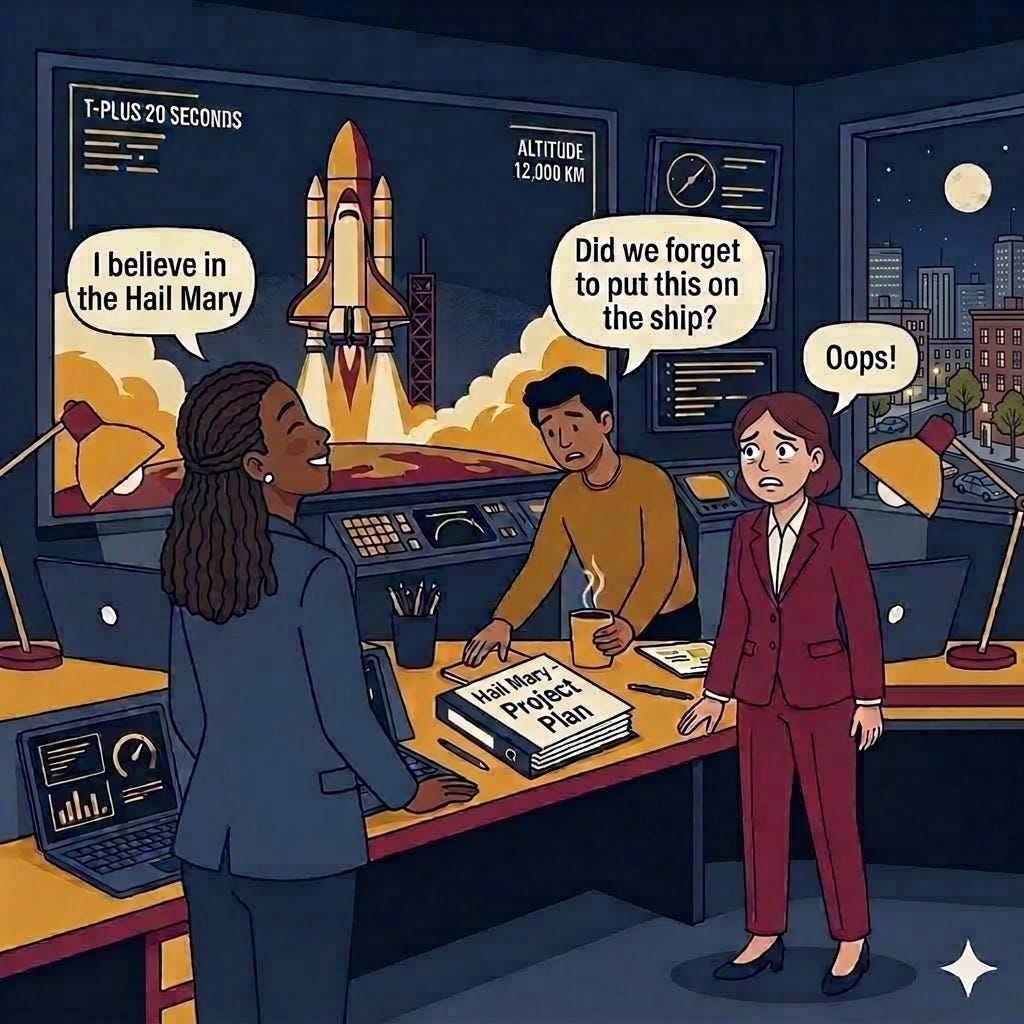
Project: The nearly hidden element in this story
Throughout the book, Mr. Weir takes us on deep dives into astrophysics, biology, and engineering - to name a few - but we never hear our narrator, Dr. Ryland Grace (a.k.a, Grace), stop to consider his project schedule or update his risk log. So while project management activities are never directly referenced in the story, if you read closely, you start to see the project, the program, and its underlying components reveal themselves.
To fully unpack this underlying element of the story, I’ll share a quick summary of the plot, then dive into how projects and the program fit into the story, and wrap up with what we can learn from our adventurers, Grace and Rocky, about project management.
Bite-sized recap
Since Project Hail Mary was originally published in 2021, I will postulate that many people read it several years ago. To jog your memories, Grace – both a middle school science teacher and savant scientist – is sent to another solar system, Tau Ceti, to investigate why that star appears unaffected by an alien microbe called Astrophage. This single-celled organism has taken up residency between the Sun and Venus, slowly absorbing the energy of Earth’s primary heat source. The result is a predicted drop in the Earth’s temperature over the upcoming decades, which is expected to annihilate humanity through painful starvation and warfare over diminishing resources.
The book unfolds across two time periods, alternating between Grace’s adventures in space and his memories of Earth as the Petrova problem evolves. The former involves meeting an adventurous alien, nicknamed Rocky, whose species faces the same threat back on his planet, while the latter focuses on hanging out with Eva Stratt, a Dutch powerhouse, as she leads the charge to save humanity.
With that framing in mind, let’s get into how project management fits into this book.
Is Project Hail Mary actually a project?
Project is an admittedly small word to capture an interstellar endeavor sent as the last hope to save humankind. While I can’t speak to why Mr. Weir did not give the book a zestier title – Mission Hail Mary, Endeavor Hail Mary - I do give him credit for using the term “project” correctly.
To review, the Project Management Institute (PMI) defines a project as:
Project: “A temporary initiative in a unique context undertaken to create value” (2, p.271).
That’s not a lot to go on here, but essentially, you’re looking for something that is a) time-bound and b) has a definitive end product. Grace certainly has a ticking clock on his mission – ultimately set by the amount of food onboard to keep him alive. His work’s value centers on answering the scientific question, “Why is Tau Ceti not dimming?” If he can discover the answer, the value created is – hopefully – the key to fixing the problem back in Earth’s solar system.
As it meets these two core criteria, Project Hail Mary is definitely a project. Similar to Mr. Weir’s diligence and accuracy in applying real scientific concepts to his stories, I’m wicked happy and not surprised that he used the word “Project” accurately in the title of his book.
If it is a project, does it have a program?
Here’s a part that gets interesting in the text. For much of the story set on Earth, Grace is sometimes part of the action and sometimes just our audience surrogate, often observing Eva Stratt as she authoritatively directs the world towards a potential solution. Through Grace, we learn about:
The discovery of the Petrova line and the Sun’s dimming (a.k.a., the Petrova problem).
Project ArcLight: The mission to send an unmanned probe to Venus to collect samples from the Petrova line.
The Guinea-Pig Phase: Grace’s experience as the first scientist to study Astrophage (as well as Stratt testing if he would die from it).
The study of Astrophage by top scientists worldwide.
The analysis of our surrounding solar systems and the discovery of one planet, Tau Ceti, that is near the center of all the infected stars, yet not dimming.
Project Hail Mary: The one-way mission to Tau Ceti to discover why this star is singularly immune to Astrophage’s effects.
Blackpanel: The paving of the Sahara desert with blackpanels to breed and harvest Astrophaege to fuel the Hail Mary spacecraft.
The bombing of Antarctica to release methane into the atmosphere and slow Earth’s cooling.
As you can see, there’s a whole suite of initiatives surrounding the Petrova problem, many of which stem from the prior initiative’s findings. Some get formal names, such as “Project ArcLight”; others get playful nicknames, such as “The Guinea-Pig Phase”; and some are only described by their purpose and activities. Throughout, holistic governing bodies are referenced, such as the “Petrova Taskforce,” but the book never gives the entire body of work a formal title unto its own. Altogether, is this actually the “Petrova Program?”
To figure that out, let’s check in with PMI’s definition of a program:
Program: “A group of related projects and program activities managed in a coordinated manner to obtain benefits not available from managing them individually” (2, p. 271).
Here, we are looking for a body of work comprising of multiple projects, typically conducted progressively over time. Further - and this is the most important difference between a project and a program - it’s aimed at creating benefits, not deliverables.
In the book, Stratt is setting up most of these individual initiatives, which, whether formally named or not, are projects. Based on each of their deliverables (often new knowledge), Stratt is determining the next aim for human efforts to address the crisis. Finally, and this is non-obvious, the objective of all her work is not the creation of a solution to Astrophage’s dimming properties, such as an astrophage-eating predator. Instead, she is set on saving humanity at any cost - made very clear when she forces Grace onto the Hail Mary. It’s not a stretch to imagine Stratt was also building silos in to the ground to isolate and preserve a small segment of the human population until the surface became habitable again. You can thank Hugh Howey (The Silo Series) and Tim Cain (Fallout) for putting that idea in my head.
And while Stratt’s work comically shines as a masterclass in cold authoritarianism, the actual foundation of her work is program management. She is coordinating a progressive, interconnected series of projects to achieve a benefit - the survival of the human species. Stratt is running the world’s largest program, and she is the ultimate program manager.
So how do they do?
This last part is the most fun. As project and program management professionals in the real world watch our timelines, manage stakeholder relationships, and engage our sponsors, it’s a kick to consider whether the characters placed in these extreme circumstances are demonstrating the best or worst practices of pro-port management*.
Here, I’ll focus solely on Grace and Rocky, because unpacking Eva Stratt as a program manager is worth its own article (hint, hint at what’s coming next for “The Non-Profit Program”).
Grace and Rocky
Of the Hail Mary’s original crew, I presume that the assigned project manager was Commander Yáo Li-Jie, who perished while in comatose during the long journey to Tau Ceti, along with their other crew member, Olesya Ilyukhina. This left the “free-spirited” Grace climbing the walls alone until he is joined by his pentagonally-shaped best-friend-in-the-universe, Rocky.
Here, Rocky replaces Ilyukhina’s role as the ship’s (or now ships’ with the Blip-A) engineer, but interestingly, there’s no surrogate for Yáo’s role on the crew. Whether intentional or not, Mr. Weir directly removed the structured project management approach from the mission. For the plot, this entertainingly frees up the characters, particularly Grace, to take bigger, less well-thought-through swings at the issues at hand. For instance, he shows no hesitation in telling an alien stranger exactly where Earth is in the universe…because humanity’s first interaction with alien life has gone so well!!!
But, I digress, despite the lack of a disciplined project management approach, Grace and Rocky do two things very, very well.
Collaboration
In recent years, PMI has focused significantly more attention on how collaboration adds to projects and programs. For instance, they added “Collaboration” as the sixth performance domain in the newest edition of “The Standard for Program Management” (3, p. 205).
The heart of Hail Mary’s story centers around the relationship between Rocky and Grace. Beyond a clear enjoyment of each other’s company, they work exceptionally well together, and the story provides a wonderful model for how a team can work together through uncertainty. They assign roles based on skill sets, provide care for one another, spend time learning about one another as holistic earthlings/eridians, brainstorm, and let their curiosity guide, but not derail, their work. If you need to think about teaming, this story is time well spent on what creates strong, creative partnerships.
Adaptability
Rocky and Grace’s other talent is how well they navigate through uncertainty and apply an adaptive approach (2, p. 63) to the project, moving efficiently and effectively to the next activity based on the knowledge gained from the last.
Admittedly, early in my career, I was trained to map out entire projects and then – not shocking – got frustrated when nothing came together that way. My training (which was not in Agile project management) never formally focused on how to build out a project in iterations, tying project components together as new information emerged, and using good judgment and solid wisdom to determine next steps.
Project Hail Mary, a story consisting of hundreds of looping “problem-investigation-discovery-decision” vignettes, is an excellent example of an adaptive approach in motion. Referring back to PMI for the formal definition:
Adaptive Approach: “A development approach in which the requirements are subject to a high level of uncertainty and volatility and are likely to change throughout the project” (2, p. 265).
These projects can’t be mapped, only estimated, leaving adaptability as one of your most important roles as a project manager: weaving together the people, knowledge, and tools as the project evolves to get to the final deliverable. Rocky and Grace do this exceptionally well and meet their goal of finding out why Tau Ceti is immune to Astrophage’s effects. Specifically, that Astrophage has a predator, Taumoeba, that keeps the Astrophage population in check, limiting its ability to dim the nearest star.
But…
Grace and Rocky have some limitations, too. Most significantly, once they found this answer, they blew right past the Hail Mary’s defined project deliverable and kept going right into a distinctly new project - the development of the nitrogen-resistant Taumoeba and its delivery to Erid and Earth. Gosh knows, Commander Yáo would have stuffed some of that harvested Taumoeba right into a beetle and sent it on to Earth as soon as they saw it ate Astophaege - particularly with the Hail Mary’s damaged haul. Only then would he have given Grace and Rocky the go-ahead to proceed with further investigation.
This is where the dynamic duo comes up a little lousy-goosey on a structured project approach, which, given that Taumoeba-82 ate their fuel supply…multiple times…was in fact a super high-risk endeavor.
So Rocky and Grace would get marked up as “Needs Improvement” in their performance reviews around risk management and not exceeding their scope of work, but hell, they did save both species. Collaboration and adaptability from these two voyagers ultimately proved the necessary skill set for success at this particular project.
“Champagne Supernova”
If you are a pro-port management professional, I hope you enjoyed this article and getting the chance to geek out over Project Hail Mary. I certainly did.
While project management and its sister disciplines (product, program, and portfolio management) have been structured specializations for decades, as a community, we are still learning about how our work actually happens. This book is one of my top recommendations for anyone seeking inspiration about the structures of our work, collaboration, and navigating through uncertainty.
In the future, I hope Mr. Weir might even consider applying his fabulous writing skills - which make science so entertaining - to the fields of project, product, program, and portfolio management more directly. I’ll even pose the development of a new genre of literature: “Pro-Port Fiction.”
This week’s song pairing is the first song from the new movie’s soundtrack: “Champagne Supernova” by Oasis. I’m looking forward to seeing the movie - and cutie patootie, Ryan Gosling - very soon.
References
Weir A. Project Hail Mary. London: Cornerstone Digital; 2021.
Project Management Institute. A guide to the project management body of knowledge (PMBOK® guide). 8th ed. Newtown Square, PA: Project Management Institute; 2025.
Project Management Institute PMI. The Standard for Program Management - Fifth Edition. Project Management Institute; 2024.
*Pro-Port Management: the application of knowledge, skills, and principles to manage a project, product, program, or portfolio.
🎵 Good good good! 🎵🎵