


On a cold, dreary day last December, you would have found me on a bench in the first-floor lobby of a sufficient but uninspired office building. Giving off a “semi-catatonic” vibe, I was trading bites of granola bar for swigs of soda, a fixed stare on the wall. Eventually, I would reach for the phone to call my husband.
“I passed,” I said flatly.
The right news. Wrong tone.
I continued, “That was awful. I don’t think I should drive the car just yet.”
After more than four hours battling through the Program Management Professional (PgMP) certification exam in a stuffy, windowless, and hot room, I was hurting. Tripped up by the questions and going too slowly at the start, I spent the last two hours fixed in place, knowing even a water break meant forfeiting my chance to finish the test.
Experiencing too much dehydration, adrenaline, heat, and stagnation, I walked out of the test mentally and physically dysregulated. But I was FINALLY in a cool area with fresh air, nourishment, and the freedom to move, eat, drink, and pee at my leisure; I was coming back from that painful cliff. Eventually, yes, I felt better and drove myself home.
But what about proving my mettle as a program management professional justified that moment? Where I should have been jubilant, I walked away angry because what I had trained for in my practice exams was NOT the test I had just taken.
Those red flags I noticed while preparing for the test (detailed in Part 9: Your $600 Bet on PgMP Readiness) absolutely reared their ugly heads on exam day - particularly the practice-exam-to-real-exam gap. I struggled through the entire four hours of my test to walk out successful, but hurt.
Now a year later, it’s clear there are opportunities for improvement. Some I will own (time management), and others are completely in the hands of the Project Management Institute (PMI). For those looking to take the PgMP certification exam one day - which I still hope you do - here’s my “Exam Day” experience and recommendations for PMI.
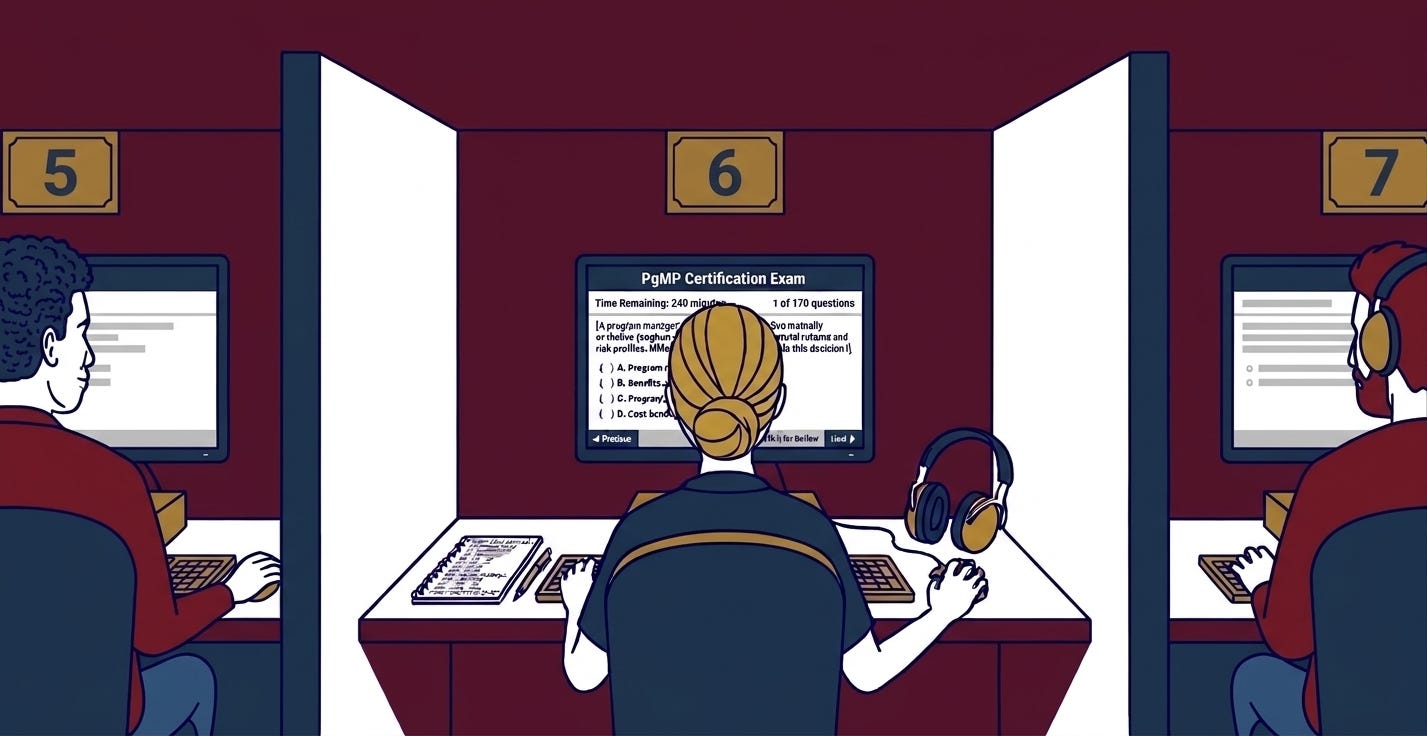
- Image created in Google Gemini on 11/11/2026
About the “Project PgMP Certification” Series
In this series, I share my journey toward PgMP certification, including my experiences with the application, educational materials, and exam. If you are considering the PgMP certification or curious about a mid-career educational adventure, this series is for you. In Part 10, I share my personal experience with taking and passing the PgMP exam.
While I strive to include accurate details about the PgMP certification process, the PMI is the final authority on all requirements and processes. Make sure to check out PMI’s PgMP website and the PgMP Handbook (1) for updates.
A special note about this article: it does not include any specific details about the test content. Like everyone pursuing PMI certification, I was required to sign PMI’s Candidate Security Acknowledgment, where I agreed that PMI exam questions, content, and answers are strictly confidential and that I would not disclose their contents. Instead, this article focuses on my activities, experiences, and feelings on exam day.
1. Test day morning
Before we get into how hard this test was, I’ll focus on the one part that went well: my morning-of preparations.
In the United States, all PMI exams are administered at professional testing centers managed by Pearson Professional Assessments. Getting ready to take a standardized exam at one of these testing centers is a lot like air travel. You need to pack the right stuff, bring ID(s), arrive with plenty of extra time to make a wrong turn and then find the right location, and even go through a type of security. Also, prepare for times when food, drink, and bathroom access will be limited.
As a proactive soul, I mentally walked through my morning schedule, mapping out every activity before I sat down for the exam. I wanted to be relaxed, well-fed, and highly caffeinated.
My day-of-prep activities included:
Scheduled an 8:00 a.m. start time for my exam, around my peak mental hours and between meal times.
Read through the exam center prep materials and watched related YouTube videos to see what testing centers looked like.
Read about the restrictions on bringing any type of food or drink into the exam center and verified directly with Pearson’s that no water was allowed at the desk - only water breaks. This was not welcome news for my constant water-sipping self, but at least I wasn’t surprised by the news on test day.
Scouted a McDonald’s in the same building as the testing center and confirmed it opened early enough (i.e., 7:00 a.m.).
Prepped a bag with snacks, drinks, and identification the night before.
Ensured my husband knew to call Pearson’s front desk if our children had some unforeseen health emergency during my exam (#caregiverconcerns).
On the morning of my test, I woke up around 5:30 a.m. and got to the testing center at 7:00 a.m. This timing got me out of the house before my young kids woke up, so I only had to focus on myself, and I beat the rush-hour traffic on the highways. Don’t worry, my husband got the kids to school.
I then enjoyed my “Big Breakfast with Hotcakes” and got properly hydrated and caffeinated while watching the sky slowly acknowledge the sunrise.
2. Finding the testing center and checking in
Around 7:30 a.m., stuffed with my McBreakfast, I walked into the office building to find the testing center.
It was, in fact, not hard to locate. As I stepped out onto the second floor, I was immediately met by a line already fifteen people deep. Everyone was already waiting for the exam center doors to open at 8:00 a.m.
As I stood in the hallway for half an hour, the entire place gave off “Big DMV Energy.”
For readers outside of the United States, that is the Department of Motor Vehicles (DMV). For readers inside Massachusetts, we call it the RMV, or Registry of Motor Vehicles. It’s where you get your driver’s license, register your car, etc. All are places that most people don’t look forward to visiting.
The setting was clean and neat, but entirely utilitarian. The crowd was quiet, absorbed in their phones, and with a lackluster energy similar to a morning commute on the T (Boston’s public transportation system). I also imagined an unspoken communal sentiment of “Let’s get this over with” bonding us as we stood in that dull hallway so early in the morning.
When the doors opened, the line shuffled in, big winter jackets and all. Eventually, I got to the front desk, where I added my name to a list that would dictate the order for the longer check-in process ahead. Sitting in the lounge area, I waited about 20–30 minutes for my name to be called.
As you weren’t allowed to have study materials once you entered the testing center, all I could really do was watch the check-in process of my earlier-arriving brethren. The crowd was distinctly young, mostly twenty-somethings, and I picked up that some were there to take Emergency Medical Technician (EMT) and nursing exams. As Pearson’s administers certification and licensing exams for hundreds of professional organizations, I imagine few people, if any, were there for PMI exams, and there was a near-zero chance that anyone else was there for a PgMP exam. While surrounded by people, I was alone in what I was about to confront.
Eventually, I was called forward, digitally signed more paperwork, showed ID, scanned my palm, took a photo, showed the inside of my sleeves, signed over the title of my car…kidding on that last one, but you get the idea. There’s a lot of activity to make sure 1) you are who you say you are and 2) that you're not trying to cheat. I was glad I hadn’t slouched on arriving 30 minutes early, as those who arrived closer to the actual 8:00 a.m. open time probably didn’t get seated for a full hour.
I put my bag of snacks and drinks in the locker, did a “for-good-measure” bathroom trip, and waited a few more minutes for another proctor to call my name. Finally, that exclusive inner door was opened, and I was on my way to take the PgMP exam.
3. Getting seated and started
Inside, the proctor led me down a winding hallway, and we popped out into a “fishbowl” of sorts where the proctors monitor the testing area from behind paneled glass. Here, I went through more checks: another self-pat-down for quarantined objects and instructions for entering the testing area.
One surprise was being handed a calculator. Somewhere along the way, I swear I read there were no calculators in PMI exams. Never questioning this assumption, I had remastered my multiplication tables and division skills. Access to this handy little device wasn't a bad turn of fortune, but it was another small moment where I realized I had gotten off track despite my best efforts.
All set to go, the proctor led me past yet another door (I’m counting door number five at this point). A touch after 8:30 a.m., I had finally made it into the inner sanctum of the exam room.
There, I was introduced to a little cubicle where I would spend the next four hours. Facing a wall, with no windows or natural daylight in sight, the tiny desk had an older desktop displaying even older software. You get a handy laminated notebook and black marker for writing too. Functional, with no more space than necessary; you sit around four feet from the next person.
I did a quick review of the “How to Use the Testing Software” tutorial to check for any surprises, and finding none, I began my PgMP exam.
4. Test time
Over the next four hours, quietly clicking away at my desk, I went through quite the inner emotional journey. To break that up, here are different challenges I experienced as I tackled this test.
Hours 1 and 2
Clock Issues
This seems silly, but I was oddly thrown off by the countdown timer. It listed time only in minutes (i.e., 240 mins) and not the more traditional hours-and-minutes format (4 hrs 0 mins) commonly found across polite society. As time ticked by, I realized I wasn’t naturally tracking time because 197 minutes doesn’t mean much to me unless I translate it into hours/minutes (3 hrs and 17 mins). Somewhere in that first hour, I realized I had a problem and stopped to draw out a table of minutes compared to desired questions completed. It wasn’t a big deal, but it was an unforeseen hiccup in my testing approach.
Pacing Struggles
I trained almost exclusively on PMtraining practice tests and could consistently complete 50 questions in 60 minutes (even across multiple tests in a row). My strategy for going into the exam was to finish all the questions in three hours, leaving a full hour for breaks and reviewing my answers. Plenty of time.
Now taking the real exam, I found that the questions and content differed from the PMtraining practice exam. Navigating this new arena, I slowed way down as I tried to figure out the new logic and question formats presented. With a four-hour runway, I felt like I had plenty of time. Unfortunately, when combined with my clock issues, I went way too slowly, particularly in that first hour.
No quick breaks
I took two breaks at the 210- and 130-minute marks. Each meant raising your hand, waiting for the proctor, completing the check-out procedure in the fishbowl, and then taking a stroll through the inner hallway, then Pearson’s front lobby, and then the outer hallway. Here you finally arrived at the office building’s communal bathrooms, where you still had to punch in a key code. Then back again into the labyrinth to complete the check-in procedure. As you can see, even moving with a sense of urgency, a break costs you at least five minutes. There was no way to just grab a sip of water and sit back down again during this test.
Midway reboot
I took that second break because I realized how much I was struggling and behind on my pacing. I needed to step back and make a new game plan. So while that second break may have looked like a nice lady walking briskly down the hall to the bathroom, inside my head a full emergency reboot was going on. I went through the swirl of adrenaline that comes with realizing you’re likely failing the test today (bye-bye to another $600 for the retest fee). Then, ignoring those crashing waves of ensuing panic, I walked myself through the new game plan: 1) keep trying my best to finish this test, 2) speed up at all costs, and 3) mentally capture as much information on the style and content of this exam for my future self. I may fail, but this was my one, very time-limited chance to pull back the curtain and actually see what this test involved.
Hours 3 and 4
Brain Drain
Unfortunately, this new plan put even more demands on my already overstrained brain. First, I sped up, devising new techniques and rules in real time to move quicker (if you’re down to the best two answers, pick one and for god's sake, MOVE ON!!!). Second, I analyzed the style and content of the test against the PMtraining exams while answering the questions. What was different? What was the same? Can I identify any trends or themes? It was like learning a new sport while you’re at the championship game. My brain worked at absolute maximum capacity. But the unfortunate fact was that, while I was halfway through my testing session and time was of the essence, there were objectively still two hours left. That’s a very long time to be at a full mental sprint.
No more breaks, no more moving, and no more water
To catch up and finish the exam, I needed to maintain an answering speed of approximately one question per minute (two minutes if absolutely needed). This meant that if I got up for another break (which would take at least 5 minutes), I definitely wouldn’t get to consider every question. While my brain stepped up to the challenge, unfortunately the rest of my body was not so affable to being put in this situation. My 40+-year-old body definitely kept pinging: “Time for a nice cool sip of water?”, “How about a little walk?”, and “Why not another bathroom run if you have the chance?”
Heat and noise
With test takers in every cubicle, the room definitely heated up in the first couple of hours. I dressed in layers and took off my sweater along the way. I wouldn’t say the heat and air quality were awful, but it was stuffy and mildly claustrophobic (again, like air travel). In the second half, this environment certainly didn’t help my noticeably dry throat. Noise also came through the walls at one point from a video playing somewhere else in the office building. It didn’t run for too long, but it was yet another noticeable distraction. I certainly missed my nice, quiet home office.
An uncommonly long test
Around the third hour, I started to realize that my once-crowded test area had thinned down to just a few folks, which helped relieve the claustrophobia. Only then did it hit me how unusually long this test actually was. Around me was a random assortment of other organizations’ tests, and everyone else got to go home, but I still remained.
5. Finishing the exam
With three minutes left, I submitted my answer to the final question (#170!). Exhausted, jittery, and admittedly, a little broken, I had no real time to review my answers. I sat back and watched the clock count down to zero, letting it auto-submit my exam. A patient heartbeat later, and whoosh, some god was smiling on me that day because the computer said I passed!?!.
By this point, no one was left directly around me, and I nearly broke down in tears. Unfortunately, these weren't the emotions of winning a year-long endeavor, but the pure relief of knowing I wouldn’t have to do this again. I called over the proctor, noticed a few souls taking tests on the other side of the center (maybe they started later?), grabbed my much-needed snack bag from the locker, and headed straight to the water fountain and then the bathroom to start addressing some of the alarm bells going off in my body. I eventually made it to the ground floor where I managed to string together enough coherent thought to recognize that I was in no state to drive. And that’s where you found me at the beginning of this story. A frustrated, jittery, but PgMP-certified individual.
5. My two recommendations for PMI
My exam day experience was not what I expected. While always keenly aware that I have an innate, longstanding struggle with standardized testing, I put in a solid effort to prepare for this exam. Based on the materials I had access to, I thought I was prepared and ready to take this test without ensuing drama.
I did not expect it to drive me to such mental strain and physical dysregulation. The test is meant to be challenging, and that’s a good thing. But the biggest issues I faced weren't intentionally designed; they were side effects of gaps in the testing process.
I’ll own my own part in the outcome of that day. My time management skills got sloppy at the beginning of the test, and small things threw me off, like the countdown timer format. If I try for another PMI certification - which I’m considering - I’ll definitely go in with a better game plan on pacing and planned breaks.
But the other half lies with PMI. In a root cause analysis, I place no blame at the feet of PMtraining, as PMI controls the actual test and the availability of information around it. Change must come from PMI and trickle through the system of third-party training companies.
To that end, here are my top two recommendations for PMI to improve the PgMP exam experience for prospective PgMP candidates, regardless of whether they ultimately pass or fail.
1. Conduct a review of the writing quality
A huge surprise when I took this test was encountering frequent writing errors. The mistakes included missing indefinite articles, misspellings, oddly worded phrases, and close-but-not-right words (the stuff that spellcheck can’t catch, like writing “camping” when you meant “clamping” or “plane” when you meant “plan”).
As a writer and reader, I’m trained to see these mistakes and become deeply irritated by them. That irritation is how you become a better writer and editor. So throughout the test, these errors picked at me like little mosquito bites. Maybe it’s bourgeois, but bad writing is an unnecessary distraction during an exam.
Further, as a program management professional, I couldn't ignore the irony that I was taking a test that judged, among many things, my attention to detail. The test didn’t appear to hold itself to the same standard.
While these were distracting annoyances, the real cost was the confusion they caused as a test taker. These spelling, writing, and grammatical errors messed with my thought process as I worked through the question’s logic and tried to identify the right answer.
To explain, in the PgMP exam, you are looking for the best answer from among many good answers, often indicated by just one or two words in the questions. You have to trust that the question writer has mastered the program management concepts outlined in the Standard for Program Management (SPM) (2) and has cleverly crafted the question. Both with misleading details, designed to send the unknowing down the wrong road, and clues that lead the program-management-proficient to the right answer.
There’s a writer-reader relationship here, and that connection immediately falls apart when you see a typo in the question. It signals the writer did NOT carefully craft the question, so are those intentional clues in the language or also mistakes? And while the first error in the test can be downplayed as an honest mistake, by the fourth and fifth typo, you start to question the whole thing.
I imagine this is not the desired “headspace” PMI is going for in its exams.
My experience is only an “n of 1,” though. I have no idea if all PgMP or PMI exams are riddled with typos or if I singularly got a bad batch of questions. The issue truly caught me off guard, especially since it didn’t mirror my experience at all with other PMI products to date, specifically the superb writing and editing of the SPM.
I strongly encourage PMI to look into the matter to confirm the writing quality of the tests. If errors are prevalent, they need to professionally edit current exams and implement better processes to ensure future exam questions are properly reviewed before mass distribution. A solidly written test would have dramatically improved my PgMP testing experience last year.
2. Release official practice exams
While I can’t openly detail how the actual exam differed from PMtraining’s practice exams, my assessment was that they were only approximations of each other. To lend a sports metaphor to this story, I showed up to ski, and PMI handed me a snowboard. Despite my skill in the former, the only result of attempting the latter is snowy faceplants.
My understanding is that PMI does not make any official practice PgMP exams available to the public nor its third-party trainers. Everyone is only working from the PgMP Handbook, Exam Content Outline (ECO) (3), and cues from the better-resourced PMP exams (where official PMI practice exams are available). If I hazarded a guess, I believe a lot of the questions I answered on PMtraining’s PgMP exams were repurposed PMP exam questions - particularly given the large amount of Earned Value Management (EVM) questions on their practice tests.
Both are admittedly good exams; I learned a lot about program management from the PMtraining practice exams and also from PMI’s exam, but they are not the same test. And that’s a problem. I studied the wrong materials and refined my skills for the wrong testing style, all of which made for a heinous, frustrating, and physically draining exam day.
To improve the PgMP testing experience, PMI needs to release an official PgMP practice exam to both third-party trainers and PgMP candidates - ideally several, but I’ll take just one to get started. A sample test would create a true cornerstone from which we can create better study materials, and PgMP candidates can verify their course of study. From a business perspective, my hope is it would make pursuit of PgMP certification more attractive, as the test - known for its great difficulty - would be more achievable.
“Practicing”
My exam day was a trial. A successful one - even though it certainly didn’t feel like it during the exam, and I look back on that day more negatively than I wish.
If you are considering PgMP certification, which I still recommend because of the excellence of the SPM, be prepared for potential typos and the practice-exam-to-actual-exam gap. Until PMI releases an official PgMP sample exam, my recommendation right now is to
Take practice exams from a broad array of third-party trainers to build your testing skills across a wide range of question complexity and style.
Keep focused on mastering the material in the SPM, and don't let the practice exams lead you astray. Use the SPM as a litmus test: if practice exams include questions on concepts that aren’t well detailed in the SPM, then move on.
I hope this detailed account of my exam day experience helps future PgMP candidates. If you’ve taken the PgMP exam - or any of PMI’s exams, for that matter - please reach out, as I’d be interested to hear about your experience. Also, if anyone’s worked off practice exams that felt well aligned with the actual test, let me know, and I’ll post it to this community.
And for this article’s song pairing, I just can’t go with anything fun or nice to listen to this week. Instead, I’m grabbing a song called “Practicing” from the movie “Whiplash”, the one where the indomitable J.K. Simmons performs his peak “Jerk” as the abusive teacher of a prodigious drummer. This song never gets too crazy, but it captures that vicious undertone and busy tension that I felt while taking the PgMP exam.
References
PgMP ® Program Management Professional (PgMP) ® Handbook Contents [Internet]. [cited 2026 Jun 11]. Available from: https://www.pmi.org/-/media/pmi/documents/public/pdf/certifications/program-management-professional-handbook.pdf?rev=d0f4f6474e9d4c07b8b9bb8786303973
Project Management Institute PMI. The Standard for Program Management - Fifth Edition. Project Management Institute; 2024.
Program Management Professional (PgMP) ® Examination Content Outline (ECO) [Internet]. 2024 [cited 2026 July 21]. Available from: https://www.pmi.org/-/media/pmi/documents/public/pdf/certifications/pgmp-exam-content-outline-english.pdf?rev=74f6af64c47f40e183f13743603851d5
Disclosure: In writing this series, I am not employed or compensated by PMI in any way. My affiliation with PMI is solely as a member and PgMP certificate holder. The experiences and opinions included here are my own.